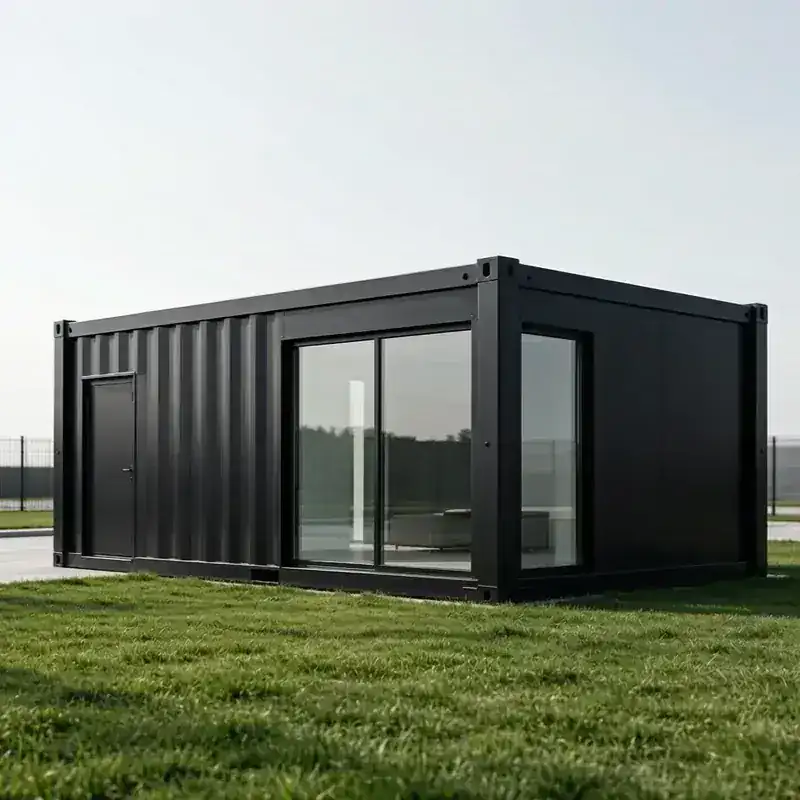
Flat Pack Container House
for Mining Camp Accommodation
Engineered for remote mining operations worldwide. Delivering complete flat pack container mining camps to Australia, South Africa, Chile, and across Africa. Bulk freight optimized — 6-8 units per 40HQ container. Rapid deployment — 2-4 hour assembly per unit with no crane required.
Engineered for Mining Camp Operations — Flat Pack Container Housing
Our flat pack container house systems are purpose-built for remote mining camp accommodation. Designed to withstand Australia's Pilbara heat, South Africa's highveld altitude, and Chile's Atacama extremes — each unit combines rapid deployability with long-term durability.
Bulk Freight Optimized
12 complete flat pack container units fit in one 40HQ container. No wasted space. Flat pack design reduces shipping volume by 75% compared to assembled containers, saving 40% on logistics costs for international mining projects.
Crane-Free Rapid Assembly
3-4 person crew assembles each unit in just 2-4 hours. No heavy crane needed — ideal for remote mining sites with limited equipment. Pre-installed electrical, plumbing, and fixtures reduce on-site work.
Extreme Climate Ready
Double-layer 50mm rock wool + EPS insulation with anti-corrosion coating. Engineered for temperature ranges -30°C to 50°C. Tested in Western Australia mining regions, South African gold fields, and Chilean copper mines.
Designed to AS 1170 Load Criteria
Structural drawings and load calculations are issued for verification against AS/NZS 1170 wind actions and the applicable seismic criteria by the project engineer. ISO 9001 certified manufacturing with full quality traceability.
Modular & Scalable
Start with 50-bed dormitories and expand to 500+ beds as your mining operation grows. Add mess halls, medical centers, offices, and recreational facilities in phases without disrupting existing camp operations.
Full MEP Pre-Installation
Electrical wiring, plumbing, HVAC ducting, and data/communication cabling pre-installed at our factory. Units arrive ready for connection to site utilities — minimal on-site MEP work required.
Dormitory Configurations
Choose 2-person supervisor quarters, 4-person standard worker dormitories, or 6-person bunk-style rooms. Each unit includes built-in storage, individual climate control, and blackout curtains for shift workers.
5-Year Structural Warranty
Galvanized steel frame with 15-20 year service life. 5-year structural warranty backed by our ISO 9001 certified manufacturing facilities. Dedicated after-sales support for all mining camp projects.
Turnkey Camp Solutions
Beyond dormitories: mess halls with commercial kitchens, administration offices, medical centers, laundry facilities, recreation rooms, and security gatehouses — complete mining camp infrastructure from one China manufacturer.
Technical Specifications — Mining Camp Flat Pack Container
Mining Camp Layout Configurations
From small exploration camps to full-scale mining operations, our flat pack container system supports multiple layout configurations. Below are three common setups used by mining corporations worldwide.
Exploration Camp (50-100 beds)
Compact setup for early-stage exploration projects. Dormitories, shared mess hall, basic medical unit. Expandable to full camp.
- 50-100 worker capacity
- 1 mess hall + kitchen
- 1 medical unit
- 2 office containers
- Assembly: 7-10 days
Standard Mining Camp (200-400 beds)
Full-scale accommodation for operational mines. Worker dormitories, supervisor quarters, large mess hall, offices, medical, and recreation.
- 200-400 worker capacity
- 250-seat mess hall
- Full medical center
- Office complex
- Assembly: 20-30 days
Mega Camp (500+ beds)
Large-scale mining camp for major operations. Multiple dormitory clusters, full amenities, separate management and contractor zones.
- 500-800+ worker capacity
- Multiple mess halls
- Hospital-grade medical
- Rec center + gym
- Assembly: 45-60 days
Featured Project: Mining Camp — Pilbara, Western Australia
A complete 200-unit flat pack container mining camp delivered to a major iron ore mining project in Western Australia. This project demonstrates our end-to-end capability for large-scale mining camp accommodation — from factory production to on-site assembly.
Delivered a complete 200-unit flat pack container mining camp to a major iron ore mining project in the Pilbara region of Western Australia. The camp includes 160 worker dormitory units (each housing 2-4 workers), supervisor quarters, a 200-seat mess hall with commercial kitchen, 4 office blocks, a medical center, and recreational facilities. All units shipped via 40HQ containers (6-8 units per container), assembled in 30 days by a 12-person crew without requiring a crane.
View Full Project DetailsGlobal Mining Camp Supply — Flat Pack Container Housing for Every Region
Our China factory has supplied flat pack container mining camp accommodation to mining projects across 5 continents. Each region's specific climate, regulatory, and logistics requirements are factored into the design.
Australia
Iron ore, gold, lithium mining in Pilbara, Kalgoorlie, Queensland. AS 1170 compliance mandatory. High-temperature resistance required for desert operations.
South Africa
Gold, platinum, diamond mining in Gauteng and North West Province. High-altitude mining camp housing with thermal insulation. Security features integrated.
Chile / South America
Copper and lithium mining in Atacama Desert and Andes highlands. Extreme altitude (>4,000m) housing solutions. Seismic-rated structures.
West Africa
Gold and bauxite mining in Ghana, Mali, Burkina Faso. Tropical climate with high humidity. Malaria-prevention design (screened windows, elevated foundation). ISO container shipping optimized.
Technical considerations for remote mining projects
A mining camp is specified by its constraints, not by its floor plan. The four that decide cost and buildability are climate, site access, services and approvals — and each one is better resolved on the drawing than on site.
Heat and cold
Pilbara summers and high-altitude nights pull the envelope in opposite directions. The panel core is the variable you can actually change: EPS is cheapest and weakest on fire performance, rock wool buys fire resistance and acoustic separation, PU sits between them on insulation and cost. Roof colour matters more than most buyers expect — a dark roof in direct sun adds several degrees to the internal temperature before any cooling runs.
Air conditioning is not part of the unit price. We supply the electrical provision and the structural mounting points for condensers; the MEP engineer sizes the units for the local design temperature. Where the site runs on generator power, tell us at quotation stage — the electrical layout and breaker sizing change.
Corrosion and dust
Coastal and inland Pilbara sites are both corrosive, for different reasons: salt in the air, and abrasive dust that works into seals and hinge lines. Specify the coating system rather than the paint colour, and budget for filter cleaning — dust ingress shortens the life of cooling equipment far more than it affects the buildings.
Structure and approvals
Structural design is project-specific: wind region, terrain category, seismic zone and the height to which you stack. We supply structural drawings and load calculations for your engineer to verify against the applicable code — in Australia, AS/NZS 1170 wind actions are the usual reference. We do not claim a certification we have not been issued; the engineer of record signs off, and that is the document the client's auditor will ask for.
Services on a remote site
Water, wastewater and power usually decide the camp layout before the buildings do. Whether ablution blocks feed a septic system or a treatment plant, whether power comes from the grid, a generator or a hybrid set, and how fuel is stored — all of this changes the block arrangement. Send the services strategy with the bed count and the layout comes back faster and cheaper.
Getting the camp to site
The freight plan matters as much as the buildings. Twelve standard 20ft flat pack units load into one 40HQ container — the unit is volume-limited rather than weight-limited, because twelve assembled units weigh about 15 tonnes, well inside the payload limit.
From the port, the constraint changes. Road trains and restricted-access routes impose width, height and axle limits that a container does not; a camp that fits a container may still need permits or a staging yard. We pack to the container loading plan and issue weights per container so your transport contractor can plan the last leg before the ship arrives, not after.
On site, a 3–4 person crew assembles each flat pack unit in 2–4 hours with hand tools and no crane. Stacking to a second storey does need lifting equipment. For camps above a few hundred beds we recommend a supervisor on site for the first blocks — the assembly is simple, but the sequence is not obvious the first time.
Documents that come with a camp order
- Structural drawings and load calculations per building type and stack height.
- Panel fire performance report for the core you specified.
- Steel and panel material certificates, plus ISO 9001 process certification.
- Electrical schematic and the layout of pre-installed circuits.
- Packing list, weights and container loading plan per shipment.
- Illustrated assembly and commissioning checklist.
If your project requires an additional test — a named fire rating, for example — raise it at quotation stage. Sourcing an extra test on the panel core is possible; discovering the requirement after the containers have sailed is not.
Questions we get from mining contractors
How many camp units fit in one container?
Twelve standard 20ft flat pack units fit in one 40HQ container. Larger or heavily fitted units load fewer — ask for the loading plan for your configuration before costing freight.
How many people are needed to build a camp?
A 3–4 person crew erects one flat pack unit in 2–4 hours with hand tools and no crane. Camp-scale erection is a matter of repeating that sequence across dozens of units, which is why we recommend a site supervisor for the first blocks.
What is the lead time?
Production and packing run to the schedule agreed at order, and the sea leg adds roughly the transit time for the route. Tell us the date the camp must be occupied and we will work back from it rather than quoting a generic lead time.
Can the camp expand later?
Yes. Flat pack units are modular, so additional blocks can be added alongside or stacked on top, provided the base and bracing were designed for the final height. Specify the growth plan at quotation stage rather than adding floors later.
Do you supply the mess hall and ablutions?
We supply dormitory, ablution, dining and office blocks, and we coordinate the camp layout. Kitchen equipment and specialist MEP fit-out are usually supplied locally to the project standard — tell us what is in scope and what your contractor will handle.
Start Your Mining Camp Project Today
Tell us your project requirements — camp capacity, location, timeline — and our engineering team will deliver a customized flat pack container mining camp solution within 24 hours. Factory-direct pricing, global shipping, full after-sales support.
Request a Quote