Quick Answer: What Is a Container ADU in California?
A container ADU is a secondary dwelling built from a steel ISO container and installed in a California backyard. A 20ft flat pack unit starts around $1,800 FOB (roughly $3,200–$5,500 landed in LA/Long Beach after freight, Section 301 tariffs and fees), and a fully installed, permitted backyard ADU typically runs $25,000–$60,000 all-in — far below California’s $150,000+ typical stick-built ADU. California is the most container-ADU-friendly state because AB 68 (2019) and SB 9 (2021) require most cities to approve qualifying ADUs ministerially.
⚠️ This is general information, not legal or engineering advice. California ADU law and city ordinances change, and seismic and energy requirements are local. Confirm your specific parcel with the city planning and building department, and have a licensed architect or engineer review the structure before you order.
Why California Leads on Container ADUs
Three forces make California the largest ADU market in the United States:
- A severe housing shortage — the state needs roughly 2.5 million more homes by 2030.
- State law that overrides local red tape — AB 68 and SB 9 force ministerial (by-right) approval of qualifying ADUs.
- ADU rental economics — a permitted ADU in coastal metros can rent for $2,000–$4,000/month, so it pays for itself fast and supports HELOC/ADU financing.
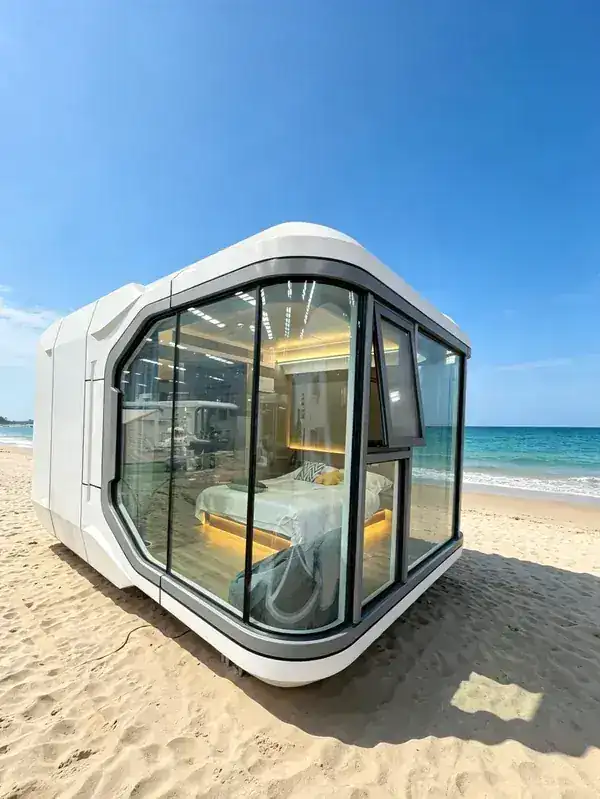
A factory-built steel container ADU arrives insulated, glazed, wired and ready — assembled in hours, no crane, which matters on tight urban and hillside lots.
The California ADU Rules That Matter
⚠️ Rules change and cities differ. Always confirm current requirements with your local planning department before ordering.
| Rule | What it means for a container ADU |
|---|---|
| AB 68 (2019) | Cities cannot require a minimum lot size, must approve ADUs ministerially in most zones, and must allow at least an 800 sq ft ADU. |
| SB 9 (2021) | Allows up to two units on a single-family lot, supporting a container ADU as a second dwelling. |
| Maximum size | Attached/convertible ADUs up to 50% of the primary; detached ADUs typically up to 1,000–1,200 sq ft. |
| Setbacks | Detached ADUs often allowed 4 ft from side/rear lots lines. |
| Parking | Generally not required near transit or when converting existing space. |
| Height | Commonly up to 16 ft, allowing a container ADU plus a mezzanine. |
| Owner-occupancy | State law has phased out most owner-occupancy requirements. |
A standard 40ft container (about 28.3 m² / 305 ft² usable) fits comfortably under the 1,000 sq ft cap, and a 20ft unit (about 13.9 m² / 150 ft²) makes an ideal studio, office or guest unit.
Container ADU Cost in California (2026)
| Item | Typical Cost (USD) | Notes |
|---|---|---|
| 20ft flat pack unit | $1,800–$2,500 FOB | Standard spec |
| 40ft flat pack unit | $3,200–$4,500 FOB | Studio-to-one-bedroom |
| Expandable (20ft→40ft) | $4,500–$6,000 FOB | Doubles floor area on site |
| Ocean freight China → LA/LB | $500–$1,200 | Per unit, LCL or FCL |
| Section 301 tariff | up to 25% of customs value | Confirm HTS code with your broker |
| Port handling & customs clearance | $250–$500 | Terminal charges and broker fees |
| Inland trucking (port to site) | $300–$1,200 | Distance dependent |
| Foundation (piers/pad) | $3,000–$8,000 | No full slab needed |
| MEP hookups & installation | $6,000–$15,000 | Power, water, sewer/septic |
| Permits & plan review | $2,000–$8,000 | City dependent |
| Typical installed total | $25,000–$60,000 | Well below stick-built ADUs |
See the full container house price USA guide and the global cost guide for line-item detail.
The Permit Path in California
- Pre-check zoning with your city — confirm ADU eligibility and any local overlays (coastal, hillside, historic).
- Order PE-stamped structural drawings — your supplier provides IBC/CRC-compliant plans for the submittal.
- Submit for a ministerial (by-right) ADU permit — California law requires approval in most zones.
- Install foundation, unit and MEP, then pass inspections.
Our USA permits & zoning guide walks through the county submission packet, timelines and fees.
Wildfire, Wind and Energy Specs
- Wildfire zones (WUI): specify non-combustible cladding, ember-resistant vents and Class A assemblies — steel frames have an inherent advantage.
- Wind/seismic: steel container structures are engineered to ASCE 7 wind and seismic loads with PE-stamped drawings.
- Title 24: add high-R insulation, double glazing and LED lighting to meet California energy code.
Site and Structure Considerations
Site conditions, not the unit, usually decide whether a California container ADU pencils out:
| Factor | What it changes |
|---|---|
| Slope | Piers or a stepped foundation instead of a slab; steep lots may make crane or forklift access impossible |
| Seismic zone | Anchorage design, bracing and engineer-stamped drawings |
| Soil | Expansive or fill soils may need deeper piers and a geotechnical report |
| Access | A 20ft module needs a clear path; narrow or gated lots may need a smaller or folding unit |
| Utilities | Distance to sewer or septic, panel capacity, gas and water runs |
| Title 24 | Insulation, glazing and lighting compliance for a permitted dwelling |
Six Steps from Order to Occupancy
- Check the parcel — zoning, ADU eligibility, setbacks, easements, fire and coastal designations.
- Confirm the numbers with the city — size limit, height, parking and fees, in writing.
- Get a local design — an architect or engineer adapts the module to the foundation and seismic requirements.
- Submit for a permit — the module’s structural drawings plus the site plan.
- Set and connect — foundation first, then the module, then utilities and finishing.
- Inspection and certificate of occupancy — only then is the ADU legally habitable.
Frequently Asked Questions
Can a container ADU be permitted in California?
Yes — under AB 68 and SB 9, qualifying ADUs must be approved ministerially in most zones. The unit must meet local height, setback and building-code requirements with PE-stamped plans.
Is a container ADU legal in California?
Container ADUs can be permitted, but the material does not change the code path: the unit must satisfy the same structural, energy and life-safety requirements as any dwelling. California’s ADU law improves the approval route for ADUs generally; the building code still governs the structure. Confirm with your city before ordering.
Do I need a full foundation?
No. Container ADUs typically sit on piers, a gravel pad or a slab-on-grade — no deep foundation, which saves cost and time.
How big can a container ADU be in California?
State law sets a floor for what cities must permit (broadly 850 sq ft detached, 1,000 sq ft attached, with a 1,200 sq ft cap in some configurations), and cities may allow more. A 40ft container is about 305 ft², so a single unit fits easily and two units can be joined. Check the current limit with your planning department.
Do I need an architect for a container ADU?
For a permitted dwelling in California, yes — you need drawings signed by a licensed architect or engineer covering the foundation, seismic anchorage and site connections.
How long does California ADU approval take?
Ministerial ADU permits are usually decided in 60–120 days depending on the city, once a complete submittal is in.
How much does a container ADU cost in California?
Budget $25,000–$60,000 installed for a 20ft–40ft unit, versus $150,000+ for a comparable stick-built ADU. Site work in the LA and SF metros is the largest variable.
Is a container ADU cheaper than a stick-built ADU?
On the shell, yes: roughly $110–$250 per square foot landed, against $150–$400 per square foot for traditional stick-built construction — plus a schedule measured in weeks for the module rather than months of framing. California site work, foundation and permits are similar for both, so the saving is concentrated in the structure and the timeline.
Related Guides
- US Container ADU Rules by State 2026 (Comparison)
- Container ADU FAQ 2026: 20 Common Questions Answered
- What Is a Container ADU? Definition, Rules & Cost
- Container ADU Washington 2026: Rules & Cost
- Container ADU Colorado 2026: Rules & Cost
- Container ADU Oregon 2026: Rules, Cost & Permits
- Container House USA: Complete Buying Guide 2026
- Container House Permits in the USA: State-by-State ADU & Zoning
- How to Import a Container House to USA
- Container House Landed Cost Calculator
- Container House Size & Dimensions
- Container Houses for Sale 2026