The Saudi Arabia Container House Market in 2026
Saudi Arabia is the largest and fastest-growing market for container housing in the Middle East — and one of the most demanding anywhere in the world. The demand is not incidental; it is a direct product of Vision 2030, the national transformation program launched to diversify the economy away from oil and built on an unprecedented pipeline of giga-projects. NEOM (with its 170 km linear city The Line), Red Sea Global, Qiddiya, Diriyah Gate, ROSHN, and a nationwide program of new airports, metro lines, mining operations, and tourism resorts together represent a construction volume that the Kingdom’s conventional building sector cannot deliver on schedule with traditional methods alone.
The result is a structural shortage of worker accommodation, site infrastructure, and fast-deployable buildings that factory-built steel container houses are purpose-designed to fill. Three forces converge in 2026:
- A construction boom measured in trillions. Vision 2030 has committed hundreds of billions of dollars to giga-projects, requiring hundreds of thousands of migrant construction workers on site at any one time — every one of whom needs compliant, safe, climate-appropriate housing under Saudi labor law and SBC 801.
- A housing shortage for citizens and residents. The Kingdom aims to raise home-ownership among Saudi families to 70% by 2030, and large-scale housing delivery is part of the plan. Container housing offers a fast track for workforce housing, temporary accommodation, and budget residential solutions.
- Explosion of tourism. Red Sea Global, the NEOM coast, and new entertainment destinations are driving demand for glamping pods, resort staff quarters, and remote-site lodges along the Red Sea coast, where conventional construction is slow and expensive.
Against this backdrop, container houses are the price and speed leader. A compliant flat pack unit ships from China in compact form, assembles on site in a day without a crane, and lands at Jeddah or Dammam at a fraction of the cost and time of a cast-in-place building. Buyers across the Kingdom — EPC contractors, labor suppliers, developers, and project owners — increasingly treat steel container units as the default procurement line item for worker accommodation, site offices, and remote facilities.
This guide is the complete buying playbook for the Saudi market: market context, applications, factory and landed prices, the import and customs process, SBC and SASO compliance, climate engineering for the Arabian Peninsula, labor camp budget planning, investment math versus conventional construction, supplier selection, and answers to the questions Saudi buyers ask us most.
Why Container Houses for Saudi Arabia?
| Benefit | Impact |
|---|---|
| Extreme Heat Ready | Engineered for 45–55°C summer temperatures with 75–100mm PU insulation |
| SBC Compliant | Meets Saudi Building Code standards, including SBC 801 worker accommodation |
| Mega-Project Speed | Flat packs install in a day with no crane; critical for giga-project timelines |
| Cost Efficiency | 50–70% savings vs conventional construction for worker housing |
| Scalable | From a single 50-worker camp to 5,000+ units across NEOM and Red Sea sites |
| Desert Proven | Sand-sealed windows, dust filtration, and anti-corrosion coatings by region |
| Rapid Deployment | Production to on-site occupancy in 6–8 weeks, anywhere in the Kingdom |
| Relocatable | Move units between sites as projects shift — no sunk foundation value |
| Climate Versatile | Same steel platform works for coastal humidity, desert heat, and highland nights |
| Code Documentation | Engineering certificates accepted by Saudi municipalities and project authorities |
Saudi buyers choose container houses for one dominant reason: compliant, habitable worker and site accommodation delivered in weeks at roughly half the cost of conventional building — with SBC engineering documentation and the speed that giga-project contracts demand. Flat pack models matter most here because they ship compact (6–8 units per 40ft container), handle rapid bulk deployment, and assemble without a crane, which suits remote desert and coastal sites where heavy equipment is scarce.
Popular Applications in Saudi Arabia
| Application | Recommended Type | Project Examples |
|---|---|---|
| Mega-Project Labor Camps | Flat Pack | NEOM, The Line, Red Sea Global construction |
| Worker & Staff Housing | Flat Pack | Oil and gas facilities, industrial cities |
| Construction Site Offices | Flat Pack / Expandable | Riyadh Metro, airports, giga-project sites |
| Project Management HQ | Expandable | Mega-project and EPC headquarters |
| Hajj & Umrah Seasonal Housing | Flat Pack | Makkah and Madinah temporary accommodation |
| Resort & Tourism Staff Quarters | Flat Pack / Expandable | Red Sea coast, NEOM coast, entertainment districts |
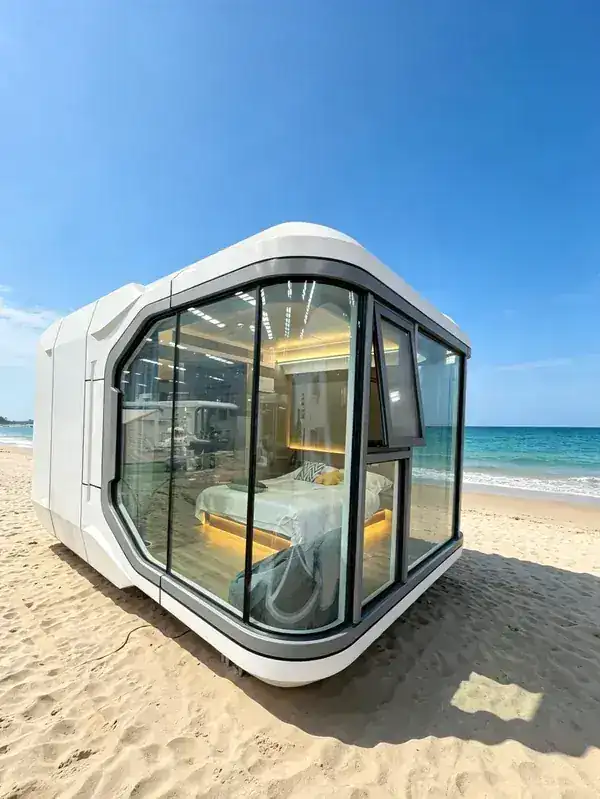
| Glamping & Eco-Lodge Hospitality | Expandable / Space Capsule | Red Sea tourism, desert resorts, coastal glamping |
| Mining & Exploration Camps | Flat Pack | Ma’aden and Northern Province mining operations |
| Agricultural Worker Housing | Flat Pack | Al Ahsa oasis and farming regions |
| Retail Kiosks & Site Canteens | Flat Pack | Industrial cities, construction sites, event venues |
| Military & Government Support | Flat Pack / Expandable | Remote facilities, border and training sites |
Worker accommodation remains the highest-velocity application in Saudi Arabia. EPC contractors and labor suppliers buy flat pack units in bulk quantities of 100–1,000+ for camps serving NEOM, Red Sea, and major urban projects. Separately, tourism developers are a fast-growing buyer group: the Red Sea coast’s resort boom is driving demand for expandable staff quarters and premium glamping capsules that must survive extreme heat and humidity simultaneously.
Container House Prices in Saudi Arabia (2026)
Prices below are consistent with the EasiHive global price system (2026): flat pack from $1,800, expandable from $4,500, folding from $2,000, space capsule from $4,000 for 20ft models. All factory prices are FOB (Ex-Works) from the China factory, including standard finishes and export packaging.
Factory Prices by Product Type
| Model | Factory Price (FOB) |
|---|---|
| 20ft Flat Pack | $1,800–$2,500 |
| 40ft Flat Pack | $3,200–$4,500 |
| 20ft Folding | $2,000–$4,000 |
| 20ft Expandable | $4,500–$6,000 |
| 40ft Expandable | $8,000–$12,000 |
| Space Capsule | $4,000–$15,000 |
| Labor Camp Dormitory (bulk, per unit) | $1,300–$2,000 |
Landed Cost by Saudi Port
Landed cost includes the factory price, ocean freight, port handling, and import duties. Saudi ports are relatively close to China — faster than any Western destination — which keeps freight competitive. Transit and handling differ by coast:
| Model | Landed at Jeddah (Red Sea) | Landed at Dammam (Gulf) | Landed at NEOM / Tabuk region |
|---|---|---|---|
| 20ft Flat Pack | $3,000–$4,500 | $3,100–$4,600 | $3,300–$4,900 |
| 20ft Folding | $3,400–$6,200 | $3,500–$6,300 | $3,700–$6,600 |
| 20ft Expandable | $6,100–$8,500 | $6,200–$8,600 | $6,500–$9,000 |
| 40ft Expandable | $10,600–$15,900 | $10,800–$16,100 | $11,200–$16,800 |
| Space Capsule | $6,400–$18,500 | $6,500–$18,700 | $6,900–$19,500 |
| Labor Camp Dormitory (bulk) | $2,500–$4,000 | $2,600–$4,100 | $2,800–$4,300 |
Port rule of thumb: Jeddah Islamic Port (Red Sea) is the fastest and least expensive for Western Province, NEOM, and northern sites; Dammam’s King Abdulaziz Port serves the Eastern Province and the Gulf. NEOM-bound cargo typically routes via Jeddah or a northern gateway, with final overland leg to the Tabuk region adding modest trucking cost. For bulk orders (10+ units), flat pack units load 6–8 per 40ft container, cutting per-unit freight by roughly 40–60%. See our Container House Cost Guide for the full cost breakdown and per-type shipping math.
Need precise Saudi pricing for your port, quantity, and model? Request a quote and we will confirm the exact landed cost to your chosen Saudi port within one business day.
Additional Saudi Costs to Budget
| Item | Cost |
|---|---|
| Import customs duty (GCC tariff) | 0–5% of CIF value |
| VAT on import (5%, refundable for registered businesses) | 5% of (CIF + duty) |
| Customs clearing / broker fees | $200–$500 per shipment |
| Port handling / terminal charges | $300–$600 per 20ft |
| Inland trucking (port to site, by distance) | $500–$4,000 per unit |
| Foundation / piers (per unit) | $800–$3,000 |
| Utility connections (typical) | $2,500–$7,000 |
| SABER / SASO conformity fees | $150–$400 per product |
Shipping to Saudi Arabia
Main Saudi Ports
| Port | Region | Transit Time | Best For |
|---|---|---|---|
| Jeddah Islamic Port | Western Province | 13–17 days | NEOM, Makkah, Riyadh, western sites |
| King Abdulaziz Port (Dammam) | Eastern Province | 14–18 days | Eastern Province, Gulf sites |
| King Abdullah Port | Western Province | 13–17 days | Rabigh, western industrial areas |
| Jubail Commercial Port | Eastern Province | 15–18 days | Jubail industrial city, petrochemicals |
| Yanbu Commercial Port | Western Province | 14–17 days | Yanbu, Madinah region |
Shipping Cost (per 20ft unit)
| Type | Cost |
|---|---|
| Flat Pack | $500–$900 |
| Folding | $700–$1,100 |
| Expandable | $900–$1,400 |
| Space Capsule | $1,500–$2,200 |
Inland Transportation
For delivery beyond the port, inland trucking applies. Saudi Arabia’s road network is well developed, and flatbeds run throughout the Kingdom on the major highways connecting Jeddah, Dammam, Riyadh, and the north.
| Distance from Port | Cost Estimate |
|---|---|
| 0–100 km | $400–$800 |
| 100–500 km | $800–$1,800 |
| 500–1,000 km | $1,800–$3,000 |
| 1,000+ km (e.g., port to NEOM/Tabuk) | $3,000–$4,500 |
Importing a Container House to Saudi Arabia
Importing container houses from China to Saudi Arabia is a well-established process. Saudi Arabia has harmonized its import regime with the Gulf Cooperation Council (GCC), so a single common customs tariff applies across the Gulf. Here is exactly how it works for a container house.
1. HS Code and Duty Rates
The correct classification for a complete prefabricated building of iron or steel is HS 9406.10 (Prefabricated buildings of iron or steel), which is a GCC-standardized classification. Related classifications include:
| HS Code | Description | GCC Duty |
|---|---|---|
| 9406.10 | Prefabricated buildings of iron or steel | 5% (often 0% for certified imports) |
| 9406.90 | Prefabricated buildings of other materials | 5% |
| 7308.90 | Steel structures and parts thereof | 5% |
Saudi Arabia applies the GCC Common Customs Tariff, typically 5% on most imported goods, with a growing list of exemptions. Under the SABER program, container housing units that meet SASO technical regulations are frequently eligible for duty relief, and goods for eligible giga-project or government uses may qualify for exemptions. In practical terms, most container house importers land at 0–5% duty depending on classification and SABER certification status. VAT at 5% applies on the CIF value plus duty; registered businesses with a VAT certificate can reclaim it.
EasiHive provides the full commercial invoice, packing list, certificate of origin, and SASO/SABER-ready technical documentation your clearing agent needs.
2. SABER and SASO Certification
Since 2020, Saudi Arabia has required many imported products to be registered under the SABER electronic platform (Saudi Product Safety Program) before customs clearance. Compliance is managed against SASO (Saudi Standards, Metrology and Quality Organization) technical regulations:
- SABER Product Certificate (PC) — issued after a conformity assessment against the relevant SASO standard; required before shipment.
- SABER Shipment Certificate (SC) — issued per shipment, tied to each customs declaration.
A qualified supplier or a Saudi-licensed conformity assessment body (CAB) manages the SABER registration on your behalf. Container houses are typically cleared under the general safety requirements with supporting engineering and quality documentation. We coordinate SABER registration with your importer of record or clearing agent to avoid customs delays.
3. Customs Clearance Steps
- Shipment departs China with full export documentation (commercial invoice, packing list, bill of lading, certificate of origin).
- SABER Shipment Certificate is issued against the pre-approved Product Certificate.
- Vessel arrives at Jeddah, Dammam, or other Saudi port; the importer of record or clearing agent files the customs declaration via the FASah platform.
- Duty (0–5%) and VAT (5%) are assessed and paid or deferred via the importer’s account.
- Cargo is released for pickup or delivery; book your truck before the ship docks to avoid terminal storage charges.
4. Choosing Your Port and Clearance Route
Import via the port nearest your site to minimize inland trucking (see the port table above), or consolidate many flat pack units in a single shipment for a camp. Using a DDP (Delivered Duty Paid) quote — where your China supplier’s forwarder handles freight, clearance, and delivery to your Saudi site — removes most of the friction for first-time importers. EasiHive supports both DDP and EXW/FOB deliveries and provides complete documentation for every shipment.
For the step-by-step version with production, QC, and payment timeline, see How to Import a Container House to Saudi Arabia.
Compliance and Building Standards
Saudi construction is governed by the Saudi Building Code (SBC), issued by the Saudi Standards, Metrology and Quality Organization (SASO) and enforced by the National Committee of the Saudi Building Code. EasiHive container houses are engineered to satisfy the applicable SBC codes:
| Standard | What It Covers |
|---|---|
| SBC 301 | Actions on Structures — wind, seismic, and load requirements |
| SBC 304 | Design of Concrete Structures (foundations and supports) |
| SBC 801 | Worker Accommodation — the key code for labor camps |
| SBC 601 / 602 | Electrical and mechanical installations |
| SBC 261 | Thermal insulation of buildings (energy efficiency) |
| SASO | Saudi Standards, Metrology and Quality Organization — product conformity |
| ISO 9001 | Factory quality-management systems |
| ISO 3834 | Welding quality for steel structures |
EasiHive containers meet SBC standards for structural loads and worker accommodation. We provide engineering certificates and structural calculations accepted by Saudi municipalities and project authorities. Worker camp projects under Vision 2030 often require additional compliance with client-specific standards — for example, Aramco SAES standards for oil and gas facilities or NEOM specifications for giga-project sites. We manufacture to these project-specific requirements and provide the documentation your engineers need.
SABER, SASO, and CE Documentation
Beyond building-code compliance, imported container houses need the SABER/SASO conformity documentation described above. Where project contracts require it, we also supply CE (EN 1090-2) certificates for steel structures, which many EPC contractors in the Gulf accept as evidence of fabrication quality. Full document sets — commercial invoice, packing list, certificate of origin, SABER registration, structural calculations, and material certificates — are provided with every shipment so your clearing agent and project engineers have everything they need.
Climate-Specific Solutions for Saudi Arabia
Saudi Arabia’s climates range from extreme inland desert heat to humid Red Sea coasts and cool highland nights. Specify insulation, glazing, and coatings for your region:
| Region | Climate Challenge | Recommended Specification |
|---|---|---|
| Riyadh / Central | Extreme heat (50°C+), sandstorms | 75–100mm PU insulation, sand-sealed windows, dust filtration |
| Jeddah / Red Sea Coast | Coastal heat, high humidity | 75mm PU, anti-corrosion coating, enhanced HVAC provisions |
| Dammam / Dhahran | Heat, high humidity, dust | 75mm PU, epoxy floor coating, sealed electrical enclosures |
| NEOM / Tabuk / North | Desert heat, cold nights | 100mm PU, thermal bridging prevention, efficient heating system |
| Jizan / Southwest | Extreme humidity and heat | 75mm PU, maximum ventilation, corrosion treatment |
| Makkah / Madinah | Intense heat, high occupancy | 75–100mm PU, high-capacity AC, robust ventilation |
| Abha / Highlands | Cool mountain climate | 50–75mm PU, moisture management, heating provisions |
| Eastern Province Fields | Heat, dust, industrial environment | 75mm PU, reinforced doors, chemical-resistant finishes |
Extreme Heat Design (for 45–55°C summers)
For Saudi summer conditions, we recommend:
- 75mm minimum PU wall insulation (100mm for NEOM and northern regions)
- Reflective roof coating (white or metallic)
- Double-glazed windows with UV filtering
- Pre-installed HVAC mounting brackets and ducting provisions
- Thermal break design to prevent heat bridging
- Enhanced roof ventilation system
- Sand-sealed window and door gaskets to block dust ingress
Ask for a regional engineering memo with your quote: EasiHive provides the load and insulation calculations for your site’s climate values, which is exactly what Saudi project authorities and inspectors want to see in the approval jacket.
Labor Camp Solutions for Saudi Arabia
Saudi Arabia’s giga-projects require worker accommodation at a scale unmatched anywhere in the world. Under SBC 801 and Saudi labor law, employers must provide safe, climate-appropriate housing with proper sanitation, dining, and recreation facilities for migrant workers. For a full site camp specification and integrated office-and-camp layout, see our site office & worker camp solution guide.
200-Worker Camp Full Budget
Here is a complete, turnkey budget for a 200-worker site camp typical of a NEOM or Red Sea project subcontractor — the configuration our buyers order most:
| Component | Specification | Quantity | Cost |
|---|---|---|---|
| Worker Dormitories (8-person) | Flat Pack, 8 beds each | 26 units | $42,000 |
| Supervisor Quarters (2-person) | Flat Pack, with private bath | 8 units | $14,000 |
| Dining Hall | Flat Pack, 4 units linked | 2 units | $16,000 |
| Kitchen | Flat Pack, commercial fit-out | 1 unit | $8,000 |
| Site Offices | Flat Pack, furnished | 4 units | $6,000 |
| Mosque / Prayer Room | Flat Pack | 1 unit | $5,000 |
| Clinic | Flat Pack, medical fit-out | 1 unit | $4,000 |
| Recreation / Rest Area | Flat Pack | 1 unit | $4,000 |
| Laundry / Washroom Blocks | Flat Pack, plumbing pre-fitted | 2 units | $6,000 |
| Shipping to Jeddah | Ocean freight + handling | — | $22,000 |
| Inland trucking to site | Port to site | — | $8,000 |
| Installation & site works | Assembly, foundation, utilities hookup | — | $18,000 |
| Total | Turnkey camp | 46 units | $153,000 |
Cost per worker: approximately $765. Against a backdrop where conventional construction of Saudi worker accommodation can exceed $2,000–$3,000 per worker, this is highly competitive for giga-project labor suppliers.
Scaling to Mega-Camp Volume
For larger deployments — 500, 1,000, or 5,000+ workers across NEOM, Red Sea Global, or Riyadh Metro — the per-unit economics improve sharply. Bulk flat pack pricing, container-optimized loading (6–8 units per 40ft), and phased delivery programs lower both unit cost and logistics spend. EasiHive has shipped large-volume camp programs for Gulf projects and manages phased production and delivery to keep your site fed with units exactly on schedule. Bulk orders (10+ units) qualify for volume pricing; see our Labor Camp Dormitory Procurement Guide for the full camp procurement playbook.
Container vs. Traditional Construction: Investment Math
| Option | Cost per Worker / per Unit | Build Time | Notes |
|---|---|---|---|
| Conventional masonry camp | $2,000–$3,000 / worker | 6–12 months | Slowest, hardest to relocate |
| Precast concrete units | $1,500–$2,500 / worker | 4–8 months | Heavy, requires major cranes |
| Modular panel units | $1,200–$2,000 / worker | 3–6 months | Better, still slow for mega-camps |
| Container house (flat pack) | $700–$900 / worker | 2–4 weeks per camp | Best value and speed |
Cost savings: Container houses typically deliver 50–70% savings versus conventional construction for Saudi worker accommodation — and the gap widens in remote sites where concrete logistics are expensive. The transportation advantage compounds it: flat pack units ship 6–8 per 40ft container, so for a 200-worker camp the entire accommodation fits in roughly four containers, versus dozens of truckloads of building materials.
The honest caveat: a container house is a steel-framed, factory-built unit with a 20–30 year service life — a value and speed play, not a legacy structure. Where it decisively wins in Saudi Arabia is worker housing, site facilities, remote and relocatable accommodation, and tourism lodges, where the payback math versus conventional building is rarely close.
Choosing a Container House Supplier for Saudi Arabia
Sourcing for the Saudi market is different from any other: you need a China factory that genuinely understands SBC compliance, SASO/SABER registration, giga-project (NEOM) specifications, desert climate engineering, and the Jeddah/Dammam shipping routes — without you hand-holding the process from thousands of miles away.
Checklist for Saudi Buyers / EPC Contractors
- Real manufacturer, not a trader — visit or request a live video tour; ask for the factory’s registered business license and production line photos/test records. See how to verify a China container house factory.
- SBC structural engineering — confirm the supplier will provide engineering calculations and certificates to the applicable SBC codes, not just generic brochures. Your camp approval depends on it.
- SABER/SASO experience — the supplier should know how to produce the documentation your Saudi importer of record needs for SABER product and shipment certificates.
- Giga-project track record — ask for references from Gulf labor camp, NEOM, or oil-and-gas projects and their specification compliance.
- Desert design capability — insulation, sand sealing, corrosion coating, and climate load memos for your region.
- ISO 9001 certification — quality-management systems for repeatable, high-volume fabrication.
- Port routing experience — confirmed transit and references for Jeddah, Dammam, and Kuwait-to-NEOM routes.
- DDP / clearance support — will the supplier’s forwarder handle SABER registration, customs clearance, and delivery to your site?
- Pre-shipment inspection — third-party inspection (SGS, Bureau Veritas) before the container is sealed.
- Spare parts and warranty — 5-year structural warranty and a spare-parts kit shipped with your order.
- Payment terms — T/T with a production-linked deposit schedule, or escrow/letter of credit for large camp orders.
EasiHive is a China container house manufacturer with Gulf labor camp delivery experience, SBC-compliant engineering, SABER-ready documentation, and a dedicated Saudi sales channel coordinating port delivery. Request a supplier quote.
FAQ
Are container houses legal in Saudi Arabia?
Yes. Container houses are widely used for worker accommodation, site offices, and remote facilities, and they are approved under SBC standards. Labor camps must comply with SBC 801 for worker housing and receive municipality approval; we supply the engineering documentation required for approval and, where applicable, project-site authorities.
Do container houses meet Saudi Building Code (SBC)?
Yes. Our units are engineered to the applicable SBC codes, including SBC 301 (structural actions), SBC 801 (worker accommodation), and SBC 261 (thermal insulation). We supply the calculations and certificates Saudi municipalities and project authorities require.
Do container houses withstand Saudi heat?
Yes, when specified for the region. With 75–100mm PU insulation, reflective roof coatings, double-glazed UV windows, and proper HVAC provisions, internal temperatures remain comfortable even at 50°C+. Specify your region (inland, coast, or highlands) with your order and we engineer accordingly.
Can container houses meet NEOM or Aramco standards?
Yes. We can manufacture and document to giga-project specifications, including NEOM specifications and Aramco SAES standards for oil and gas facilities. Provide the specific requirements with your inquiry and we will engineer and document to meet them.
What import duty applies when buying from China?
Container houses enter under HS 9406.10 with a GCC common tariff typically of 0–5%, depending on classification and SABER/SASO certification status. VAT of 5% applies on the CIF value plus duty; registered businesses can reclaim it. On a typical unit the total customs bill is small relative to the purchase price.
Do I need SASO / SABER certification to import?
Yes. Saudi Arabia requires imports to be registered on the SABER platform against SASO technical regulations before customs clearance. This is a standard, well-documented process managed by a licensed conformity assessment body; your supplier and clearing agent coordinate it so your shipment clears without delay.
How long does shipping to Saudi Arabia take?
Shipping from China to Jeddah or King Abdullah Port takes 13–17 days; to Dammam 14–18 days. Total from factory order to arrival is typically 45–65 days, including production (15–25 days) and booking.
How much does a container house cost in Saudi Arabia total?
Factory prices start at $1,800 for a 20ft flat pack, $2,000 for folding, $4,500 for expandable, and $4,000 for a space capsule. Landed at Jeddah: roughly $3,000–$4,500 for a 20ft flat pack, with Dammam and NEOM-region delivery modestly higher. A finished, move-in-ready worker unit lands at $700–$900 per worker for camp volume.
Can I finance or use these units as relocatable assets?
Financing varies; for corporate and EPC buyers, units are typically procured as capital equipment or accounted under project cost structures, and relocatability means their value carries to the next site rather than being sunk. Individual buyers can finance via business or specialized loans where the unit is treated as equipment. Insurance is available on container units as property or equipment; provide the engineering documentation to your insurer.
Can I move or resell the units later?
Yes — a key advantage. Container houses are relocatable: units can be disassembled, transported to a new site, and reinstalled, or resold as secondhand units. For Saudi projects where sites shift and camps relocate, this flexibility preserves asset value that conventional construction loses entirely.
What cooling systems work with container houses?
Container houses support split AC, central HVAC, and evaporative cooling. For Saudi summers we pre-install mounting brackets, ducting provisions, and electrical connections for your chosen cooling system, and recommend high-capacity units and reflective roof coatings for inland and coastal sites.
Get a Quote for Saudi Arabia
Contact EasiHive for factory-direct pricing to Saudi Arabia. We:
- Engineer to SBC standards with SASO/SABER-ready documentation
- Ship to Jeddah, Dammam, King Abdullah Port, Jubail, and Yanbu
- Support DDP delivery and customs clearance to your Saudi site
- Manufacture to NEOM, Aramco, and project-specific specifications
- Offer bulk pricing for labor camp programs of 10 to 5,000+ units
- Provide desert-climate engineering for every Saudi region
Send your city/region, unit type, and quantity, and we will return a line-item landed-cost quote for your chosen port within one business day.
Related Guides
- How to Import a Container House to Saudi Arabia
- Container Houses in UAE
- Container Houses in Qatar
- Container Houses in Oman
- Container Houses in Bahrain
- Container Houses in Kuwait
- Container House Cost Guide 2026
- Container House Buying Guide
- Container House Comparison
- Labor Camp Dormitory Procurement Guide
- Mining Camp Container Housing Guide
- Container House Installation Guide