Container House Price in Australia in 2026
Australia is a natural market for container-based building. Vast distances, remote resource sites, and some of the highest conventional construction costs in the world make factory-built units land at a fraction of a site-built price — provided they are specified for Australian conditions. Conventional low-rise construction typically runs AUD 2,500–4,500 per square metre, against which a fully landed container unit is frequently 25–45% cheaper.
This guide covers the real 2026 numbers in both US dollars and Australian dollars (AUD): the factory price, the landed cost after duty and GST, the bushfire (BAL) and cyclone upgrades that Australian conditions demand, foundation and installation, and the bulk economics that drive the mining, agriculture, and tourism sectors.
Container House Prices by Type (2026)
| Type | 20ft Price (USD) | 20ft Price (AUD) | 40ft Price (USD) | 40ft Price (AUD) |
|---|---|---|---|---|
| Flat Pack | $1,800–$2,500 | AUD 2,750–3,800 | $3,200–$4,500 | AUD 4,900–6,900 |
| Expandable | $4,500–$6,000 | AUD 6,900–9,200 | $8,000–$12,000 | AUD 12,200–18,300 |
| Folding | $2,000–$4,000 | AUD 3,050–6,100 | – | – |
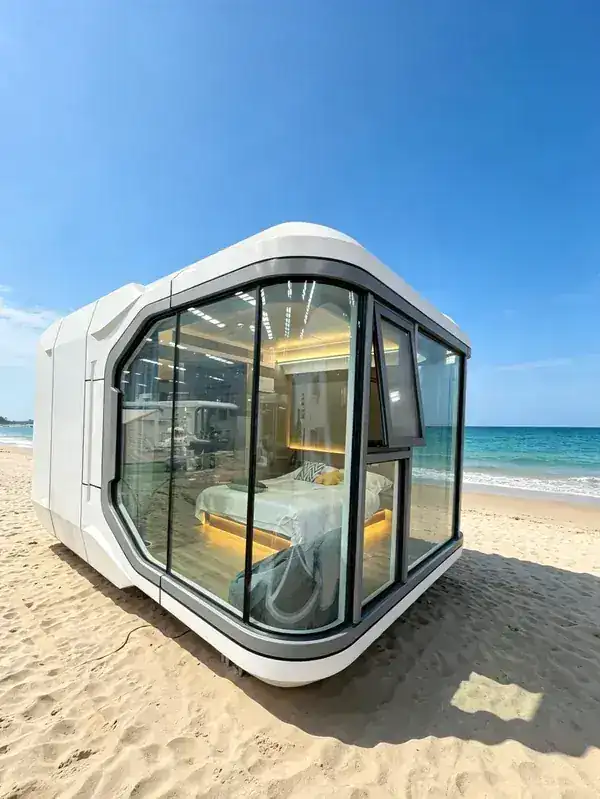
| Space Capsule | $4,000–$15,000 | AUD 6,100–22,900 | – | – |
Exchange rate note: The Australian dollar floats and is typically around AUD 1.50–1.55 = US$1. Unlike pegged currencies, your AUD budget moves with the exchange rate, so lock pricing or hedge when you place a large order. All unit prices above are FOB / Ex-Works from the China factory, before freight, duty, and GST.
Total Landed Cost Calculator for Australia
The factory price is only the starting point. Here is the full breakdown for a standard 20ft flat pack unit delivered and installed near a capital city.
| Item | Cost (USD) | Cost (AUD) | Notes |
|---|---|---|---|
| Unit (20ft flat pack) | $1,800–$2,500 | AUD 2,750–3,800 | Standard spec, white exterior |
| Ocean freight (China → Sydney/Melbourne) | $500–$1,000 | AUD 760–1,530 | Single unit, LCL or 20ft FCL |
| Import duty (0–5% on prefab buildings) | $0–$125 | AUD 0–190 | HS 9406 classification; often 0% under tariff schedule |
| GST (10%) | $230–$360 | AUD 350–550 | Applied to CIF + duty |
| Port handling & customs clearance | $250–$500 | AUD 380–760 | Terminal charges, broker fees |
| Inland trucking (port → site) | $300–$900 | AUD 460–1,380 | Remote sites cost far more |
| Foundation (concrete slab or piers) | $1,000–$2,500 | AUD 1,530–3,830 | Reactive soils common |
| Installation labor (3–4 workers) | $400–$900 | AUD 610–1,380 | 2–4 hours for flat pack |
| Crane / forklift | $200–$500 | AUD 310–770 | Often avoidable with flat pack |
| Utility connections | $1,500–$4,000 | AUD 2,300–6,100 | Power, water, septic where off-grid |
| Council / certifier fees | $500–$2,000 | AUD 770–3,060 | DA or CDC pathway varies by state |
| Total Landed Cost | $6,700–$15,300 | AUD 10,300–23,400 | Per 20ft unit |
Key insight: The all-in cost runs 3–6× the factory price once freight, duty, GST, foundation, and installation are added. Remote sites — the rule rather than the exception in Australia — push the multiplier higher because inland trucking and utility connections dominate the budget.
Cost by State / City
| Location | Foundation Cost | Installation Cost | Approval Complexity |
|---|---|---|---|
| Sydney (NSW) | AUD 2,500–5,000 | AUD 1,400–2,600 | Medium-High (Sydney Water, BAL) |
| Melbourne (VIC) | AUD 2,200–4,500 | AUD 1,300–2,400 | Medium |
| Brisbane (QLD) | AUD 2,000–4,500 | AUD 1,200–2,300 | Medium (cyclone north) |
| Perth (WA) | AUD 2,000–4,000 | AUD 1,200–2,300 | Medium |
| Remote / regional | AUD 3,000–7,000 | AUD 1,800–3,500 | High (distance, services) |
Two factors drive most variation: soil reactivity (expansive clay in many states demands pier or waffle-slab foundations) and bushfire attack level (BAL), which can require ember-proof screens, non-combustible cladding, and sealed openings.
How to Stay Within Budget
1. Ship flat pack, and ship in volume Flat pack units cost 40–60% less than expandable models and pack 6–8 units per 40HQ container. For a single unit, freight to a capital port is $500–1,000; on a 24-unit order, per-unit freight falls to roughly $250–450. This is the largest lever for Australian projects.
2. Specify for your hazard zone — and nothing more Australia needs either BAL-rated cladding and screens (bushfire-prone areas) or cyclone-rated (NCC Wind Region C/D, Far North Queensland and the Top End) structure. Specify the rating your site actually requires; over-specifying for a low-risk site wastes budget.
3. Budget the foundation before you order Foundation is commonly 20–35% of total project cost and is the most underestimated line. On reactive clay, confirm whether piers or a waffle slab are required before committing to a budget.
4. Confirm the approval pathway early Most states allow container dwellings via a Complying Development Certificate (CDC) or a Development Application (DA) with a certified building surveyor. Confirming whether your unit is a dwelling, a granny flat (secondary dwelling), or temporary accommodation before you order avoids the costliest delay: a delivered unit that cannot be occupied.
Mining, Farm & Tourism Bulk Economics
Remote accommodation is the dominant container application in Australia, and it is where the economics are most compelling.
| Component | Configuration | Indicative Cost (USD) |
|---|---|---|
| Dormitory units (4 bunks each) | 20ft flat pack, bulk price | $1,800–$2,500 per unit |
| Washroom / shower units | 20ft, pre-plumbed, 4 stalls | $2,400–$3,200 per unit |
| Camp kitchen / canteen units | 2–3 linked units | $6,400–$10,500 per block |
| Laundry + storage unit | 20ft flat pack | $1,800–$3,000 |
| Site office / gatehouse | 20ft flat pack | $1,800–$3,000 |
| Freight (consolidated, 25+ units) | 6–8 units per 40HQ | $250–$550 per unit |
| Foundation, utilities, installation | Site-wide | $90–$300 per m² of camp |
At scale, the per-bed cost of a container camp typically lands 30–50% below a conventionally built equivalent, and the camp becomes operational in weeks. EasiHive has delivered comparable accommodation compounds for remote resource and infrastructure programmes across the APAC region.
Container House vs Traditional Construction in Australia
| Option | Cost per m² (AUD) | Build Time | Lifespan |
|---|---|---|---|
| Traditional brick / low-rise | AUD 2,500–4,500 | 6–12 months | 30+ years |
| Prefab / modular home | AUD 1,800–3,200 | 2–4 months | 25+ years |
| Container house (flat pack, landed) | AUD 1,700–3,400 | 2–4 weeks | 15–20 years |
| Container house (expandable, finished) | AUD 2,600–4,400 | 4–8 weeks | 20–30 years |
Container construction typically lands 25–45% below conventional building on a per-square-metre basis for a single unit, and the gap widens on bulk orders. The trade-offs are a shorter design life and the need to satisfy NCC and council approval. For mining camps, farm stays, tourist accommodation, granny flats, and site offices, the advantage is decisive.
Get an Australia Price Quote
For an exact, line-item quote, contact EasiHive with:
- Your state and site access details (metro, regional, or remote)
- Number of units and container type (flat pack, expandable, folding, space capsule)
- Application (mining camp, farm stay, tourism, granny flat, site office)
- Hazard rating requirements (BAL level, cyclone region, termite)
- Whether you require engineering documentation for certifier submission
We provide factory-direct pricing, Australian-condition specifications, and shipping to Sydney, Melbourne, Brisbane, Perth, and Adelaide.
FAQ
How much does a container house cost in Australia?
A 20ft flat pack unit costs AUD 10,300–23,400 ($6,700–15,300) fully landed and installed near a capital city. The factory price starts at AUD 2,750 ($1,800), but freight, duty, 10% GST, foundation, and installation bring the all-in figure to roughly 3–6× the factory price. Remote sites cost more.
What import duty and GST apply to a container house in Australia?
Prefabricated buildings (HS 9406) are often 0% duty under the tariff schedule, though classification should be confirmed with your broker. GST of 10% applies to the imported value (CIF + duty). State taxes do not apply at import, but council and certifier fees apply at the building stage.
Are container houses legal in Australia?
Yes, when built to the National Construction Code (NCC) and approved by a certified building surveyor via a CDC or DA. Requirements vary by state and by whether the unit is a dwelling, secondary dwelling (granny flat), or temporary accommodation. Bushfire (BAL) and cyclone (wind region) ratings must be met for the site.
Can container houses handle Australian heat and bushfire risk?
Yes, when specified correctly. Bushfire-prone sites need BAL-rated cladding, ember-proof screens, and sealed openings; northern Australia needs cyclone-rated structure to NCC Wind Region C/D. Standard tropical or temperate specs are not adequate for high-hazard zones.
How fast can a container camp be deployed in Australia?
Production typically takes 15–25 days, sea freight from China to an Australian port adds roughly 14–25 days, and a crew can assemble a camp quickly on site. Order-to-occupancy is commonly 8–14 weeks, against 6–12 months for a comparable site-built facility — a critical advantage for remote mining and infrastructure programmes.