Container House Price in USA in 2026
The United States is the largest but most fragmented container-home market in the world. Conventional construction runs $150–$400 per square foot depending on region, against which a factory-built container unit can land 20–40% cheaper — but U.S. outcomes depend heavily on state and even city-level zoning, tariffs, and climate specs. This guide gives the real 2026 numbers.
We cover the factory price, the landed cost after Section 301 tariffs and state sales tax, the hurricane and wildfire upgrades U.S. conditions demand, foundation and installation, and the bulk economics behind ADUs, backyard offices, and workforce housing.
Container House Prices by Type (2026)
| Type | 20ft Price (USD) | 40ft Price (USD) |
|---|---|---|
| Flat Pack | $1,800–$2,500 | $3,200–$4,500 |
| Expandable | $4,500–$6,000 | $8,000–$12,000 |
| Folding | $2,000–$4,000 | – |
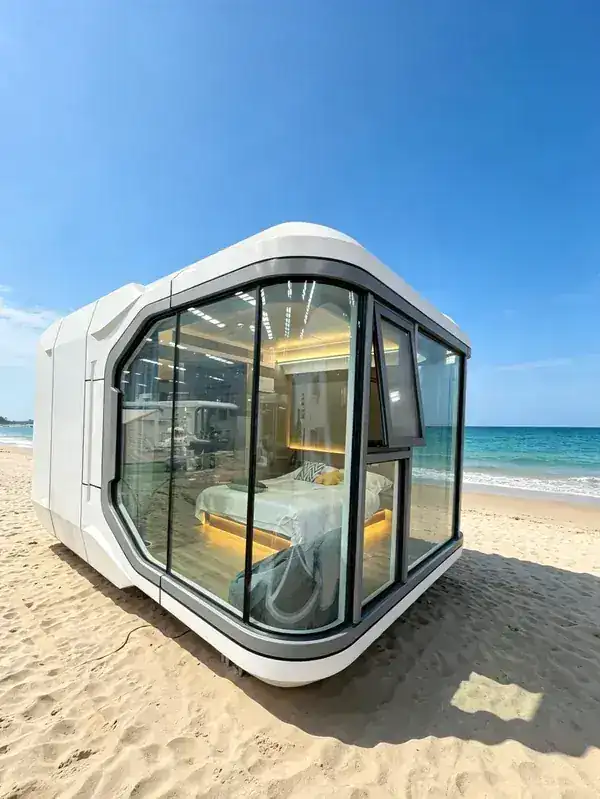
| Space Capsule | $4,000–$15,000 | – |
Tariff note: Goods from China are currently subject to Section 301 tariffs, which can add up to 25% to the imported value for many prefab building categories, on top of any base duty. This is the single biggest variable in U.S. container-house pricing and should be confirmed with your broker against the correct HTS code before budgeting.
Total Landed Cost Calculator for USA
The factory price is only the starting point. Here is the full breakdown for a standard 20ft flat pack unit delivered and installed in a major metro area.
| Item | Cost (USD) | Notes |
|---|---|---|
| Unit (20ft flat pack) | $1,800–$2,500 | Standard spec, white exterior |
| Ocean freight (China → LA/LB, Houston, NY/NJ) | $500–$1,200 | Single unit, LCL or 20ft FCL |
| Section 301 tariff (up to 25%) | $450–$1,250 | Applied to customs value; confirm HTS |
| Base duty (often 0% for prefab) | $0–$125 | HTS dependent |
| State sales / use tax (0–10%) | $0–$900 | Varies by state and county |
| Port handling & customs clearance | $250–$500 | Terminal charges, broker fees |
| Inland trucking (port → site) | $300–$1,200 | Distance dependent |
| Foundation (slab or piers) | $1,000–$3,000 | Frost/ seismic/ hurricane zones vary |
| Installation labor (3–4 workers) | $400–$900 | 2–4 hours for flat pack |
| Crane / forklift | $200–$500 | Often avoidable with flat pack |
| Utility connections | $1,500–$5,000 | Power, water, sewer/ septic |
| Permits & inspections | $500–$3,000 | City/ county dependent |
| Total Landed Cost | $6,900–$20,100 | Per 20ft unit |
Key insight: The all-in cost runs 3–8× the factory price, and the multiplier is unusually volatile because Section 301 tariffs and state sales tax differ sharply by product classification and location. Always budget the landed, tariff-included number.
Cost by Region
| Region | Foundation Cost | Installation Cost | Approval Complexity |
|---|---|---|---|
| California (LA, SF) | $2,500–6,000 | $1,500–3,000 | High (Title 24, seismic) |
| Texas (Houston, Dallas) | $1,500–4,000 | $1,200–2,500 | Medium (wind/ hurricane) |
| Florida (Miami, Orlando) | $1,800–4,500 | $1,300–2,600 | High (hurricane, HVHZ) |
| New York / Northeast | $2,500–6,000 | $1,500–3,000 | High (energy code, frost) |
| Mountain / Midwest | $1,500–4,000 | $1,200–2,500 | Medium |
Two factors dominate: climate rating (hurricane HVHZ in coastal FL, wildfire in CA, snow load in the north) and local zoning/ ADU rules, which vary enormously even within a state.
How to Stay Within Budget
1. Ship flat pack, and ship in volume Flat pack units cost 40–60% less than expandable models and pack 6–8 units per 40HQ container. For a single unit, freight to a U.S. port is $500–1,200; on a 24-unit order, per-unit freight falls to roughly $250–500. This is the largest lever for U.S. projects.
2. Get the HTS classification right The difference between a 0% and a 25% rate hinges on the HTS code your broker uses. Engage a customs broker early and confirm the classification — it can swing total cost by thousands of dollars per unit.
3. Budget the foundation before you order Foundation is commonly 20–35% of total project cost and is the most underestimated line. Coastal, seismic, and frost zones all change the design, so confirm requirements for your county before committing.
4. Confirm the zoning and ADU pathway early Container dwellings sit in a legal gray area in many jurisdictions. States like California, Texas, and Colorado are comparatively friendly; others restrict them. Confirm whether your unit qualifies as an ADU, an accessory structure, or requires full dwelling approval before you order.
ADU, Office & Workforce Bulk Economics
Accessory dwelling units and backyard offices are the fastest-growing U.S. container applications, and workforce housing is where bulk economics shine.
| Component | Configuration | Indicative Cost (USD) |
|---|---|---|
| ADU / studio unit | 20ft or 40ft flat pack, finished | $6,000–$18,000 landed |
| Backyard office | 20ft flat pack | $5,000–$12,000 landed |
| Dormitory units (4 bunks) | 20ft flat pack, bulk | $1,800–$2,500 per unit |
| Washroom / shower units | 20ft, pre-plumbed | $2,400–$3,200 per unit |
| Site office / gatehouse | 20ft flat pack | $1,800–$3,000 |
| Freight (consolidated, 25+ units) | 6–8 units per 40HQ | $250–$500 per unit |
| Foundation, utilities, installation | Site-wide | $80–$300 per m² |
At scale, container workforce housing typically lands 30–50% below a conventionally built equivalent, and becomes operational in weeks rather than months — a decisive advantage for disaster relief, agriculture, and remote industrial programmes.
Container House vs Traditional Construction in the USA
| Option | Cost per ft² (USD) | Build Time | Lifespan |
|---|---|---|---|
| Traditional stick-built | $150–$400 | 6–12 months | 30+ years |
| Prefab / modular home | $120–$250 | 2–4 months | 25+ years |
| Container house (flat pack, landed) | $110–$250 | 2–4 weeks | 15–20 years |
| Container house (expandable, finished) | $160–$350 | 4–8 weeks | 20–30 years |
Container construction typically lands 20–40% below conventional building on a per-square-foot basis for a single unit, and the gap widens on bulk orders. The trade-offs are a shorter design life and the need to clear local zoning/ ADU approval. For ADUs, backyard offices, workforce housing, and temporary facilities, the advantage is decisive.
Get a USA Price Quote
For an exact, line-item quote, contact EasiHive with:
- Your state and site access details (coastal, metro, rural)
- Number of units and container type (flat pack, expandable, folding, space capsule)
- Application (ADU, backyard office, workforce housing, retail)
- Climate requirements (hurricane, wildfire, snow load)
- Whether you require engineering documentation for permit submission
We provide factory-direct pricing, U.S.-climate specifications, and shipping to Los Angeles, Houston, New York, and Savannah.
FAQ
How much does a container house cost in the USA?
A 20ft flat pack unit costs $6,900–$20,100 fully landed and installed in a major metro area. The factory price starts at $1,800, but freight, Section 301 tariffs (up to 25%), state sales tax, foundation, and installation bring the all-in figure to roughly 3–8× the factory price. The tariff rate is the biggest swing factor.
What tariffs and taxes apply to a container house imported to the USA?
Expect Section 301 tariffs of up to 25% on many China-origin prefab building categories, plus any base duty (often 0% for prefab), plus state sales/ use tax of 0–10% depending on location. The exact rate depends on the HTS code — confirm with a customs broker before budgeting.
Are container houses legal in the USA?
It depends on the jurisdiction. There is no single federal rule; container homes are governed by local zoning and building departments, often referencing the IRC. States like California, Texas, and Colorado are relatively friendly, especially for ADUs, while others restrict them. Always confirm with your city or county before ordering.
Can container houses handle U.S. hurricanes and wildfires?
Yes, when specified correctly. Coastal Florida needs hurricane-rated (HVHZ) structure and impact glazing; California needs wildfire-resistant cladding and ember-proof vents; northern states need snow-load-rated roofs. Standard tropical specs are not adequate for these hazards.
How fast can a container house be deployed in the USA?
Production typically takes 15–25 days, ocean freight from China to a U.S. port adds roughly 18–30 days, and a crew can assemble units on site in days. Order-to-occupancy is commonly 8–14 weeks, against 6–12 months for a comparable site-built facility.