Quick Answer: Can a Container B&B Be Profitable?
Yes, and often with faster payback than a traditional build, because construction cost and time are much lower. The maths is straightforward: a furnished 20ft suite costing around $35,000 rented at $120 per night at 55% occupancy (about 200 nights) generates roughly $24,000 a year in revenue; after operating costs, payback is commonly 2–4 years. A 40ft family unit costing around $55,000 at $180 per night and 60% occupancy pays back in a similar window. Location, finish and occupancy drive the result far more than the container itself.
The Container Hospitality Opportunity
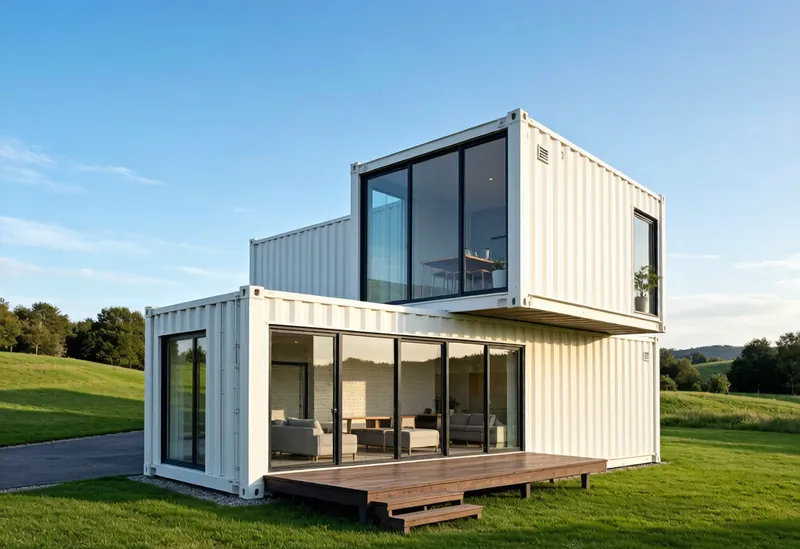
Containers are a strong base for B&Bs, guesthouses and boutique rentals:
- Fast to build — a fitted unit can be on site and open in weeks, not years.
- Photogenic — industrial lines and large glazing create a distinctive, marketable look.
- Modular — start with one unit and add more as demand grows.
- Relocatable — reposition units if a location underperforms.
- Cost-controlled — factory production keeps build cost predictable per unit.
A single unit can be a private rental; a cluster of four to eight becomes a small retreat with shared amenities.
Unit Types and Guest Capacity
| Type | Footprint | Guests | Best for |
|---|---|---|---|
| Studio suite | 20ft (~14.8 m²) | 2 | Couples, solo travellers, short stays |
| One-bedroom suite | 20ft expandable | 2–3 | Couples wanting a living area |
| Family unit | 40ft (~29.7 m²) | 4–6 | Families, two-bedroom layout |
| Luxury suite | 20–40ft | 2–4 | Premium pricing, deck, bath, views |
| Multi-unit cluster | 4–8 units | 8–32 | Boutique retreat, glamping site |
Design for Guests (What They Actually Expect)
Guests compare your unit with a hotel room, so the fit-out matters more than the container:
- Private bathroom with reliable hot water and good pressure.
- Kitchenette or a breakfast option; a small fridge and coffee setup at minimum.
- Comfort — 75–100 mm insulation, quiet air conditioning and heating, blackout blinds, and acoustic separation if units are close together.
- Wi-Fi and generous power plus USB outlets at both bedside and desk.
- Outdoor space — a private deck, seating, fire pit or garden view.
- Parking and clearly signposted access.
- Storage — luggage space, hanging space and somewhere for wet gear.
Small details — a decent mattress, blackout blinds, a view-framing window — convert far better than an extra square metre.
Multi-Unit Layout
- Face units outward or stagger them to maximise privacy and views.
- Share amenities (fire pit, BBQ, lounge) rather than duplicating them in every unit.
- Separate service access for linen, cleaning and waste from guest paths.
- Cluster services (power, water, data) along a spine so additional units can connect without re-trenching.
- Solar plus battery can offset operating costs on remote or off-grid sites.
The Numbers: Build Cost, ADR, Occupancy, Payback
| Item | Studio (20ft) | Family (40ft) |
|---|---|---|
| Unit + fit-out (furnished) | ~$35,000 | ~$55,000 |
| Average daily rate (ADR) | $120 | $180 |
| Occupancy | 55% (~200 nights) | 60% (~219 nights) |
| Gross annual revenue | ~$24,000 | ~$39,400 |
| Operating costs (cleaning, utilities, platform fees, maintenance) | ~35% | ~40% |
| Net annual income | ~$15,600 | ~$23,650 |
| Indicative payback | ~2.2 years | ~2.3 years |
These are illustrative and vary widely with location, season and marketing. The point is that payback is driven by occupancy and nightly rate, so a better location or finish usually beats a cheaper unit.
Revenue Levers
- Location — proximity to demand (coast, city, event venue, national park) outweighs almost everything else.
- Finish level — premium fit-out supports a higher ADR and better reviews.
- Off-season demand — target remote work, couples’ retreats, or event weekends to smooth occupancy.
- Add-ons — breakfast baskets, firewood, bikes, tours, or late checkout raise revenue per stay.
- Reviews and repeat guests — consistent quality and clear communication drive repeat and referral bookings.
- Direct booking — reducing platform commission improves net income on repeat guests.
Permits and Rules
Short-term rental rules are usually stricter than for a private home:
- Zoning — confirm that short-term accommodation is permitted on the parcel.
- Registration or licence — many jurisdictions require short-term rental registration and display of a licence number.
- Health and safety — fire exits, smoke and CO alarms, water and waste compliance.
- Building approval — the units themselves still need building consent as habitable structures.
- Tax and occupancy rules — tourist levies and local occupancy limits may apply.
Check the rules before you buy, because a beautiful unit in a non-compliant location has no business.
Off-Season and Repeat Stays
Occupancy is rarely uniform across the year, and off-season is where many operators lose money:
- Design for year-round comfort, not just peak-season weather.
- Market shoulder-season offers (midweek, long-stay, remote work packages).
- Add weatherproof shared space — a covered deck or firepit — so guests use the site outside peak months.
- Encourage repeat and referral bookings, which cost far less than new guest acquisition.
Checklist Before You Build
- Confirm short-term rental zoning and registration in your jurisdiction.
- Validate local demand and achievable ADR from comparable listings.
- Choose unit type and count to match your target guest and site.
- Specify insulation, HVAC and glazing for year-round comfort.
- Plan services (power, water, waste, Wi-Fi) and future unit expansion.
- Budget fit-out, furnishing and landscaping, not just the shell.
- Model payback with a conservative occupancy assumption.
FAQ
Is a container B&B profitable?
It can be, and often with faster payback than a traditional build because construction cost and time are lower. Profitability is driven mainly by location, occupancy and nightly rate — a well-located, well-finished unit commonly pays back in 2–4 years.
How many guests fit in one container?
A 20ft studio suits 2 guests, a 20ft expandable suits 2–3, and a 40ft unit fits 4–6 in a two-bedroom layout. For higher capacity, plan multiple units rather than overloading one.
Do I need special permits for a container guesthouse?
Usually yes: short-term rental registration, zoning approval, fire and safety compliance, and water/waste rules, plus building consent for the units themselves. Requirements vary widely by jurisdiction, so check before you buy.
Can I expand later?
Yes — this is one of the main advantages. Containers are modular, so you can add units as demand grows. Plan pad space and service capacity for future units at the initial design stage.
How much does a container guesthouse cost to build?
A furnished 20ft suite is commonly around $35,000, and a 40ft family unit around $55,000, depending on specification, destination and fit-out level. Land, services and landscaping are additional.
What occupancy do I need to break even?
It depends on your ADR and operating costs, but most operators need roughly 40–50% occupancy to cover operating costs and debt on a container unit. Model it with conservative numbers before committing.
Is a container unit comfortable enough for guests?
Yes, when specified properly: 75–100 mm insulation, quiet air conditioning and heating, blackout blinds and good acoustic separation. Guests judge the comfort and finish, not the container.
Can I run a container B&B off-grid?
Yes. Solar plus battery, water storage and a holding tank make off-grid operation practical, which opens up remote and eco-tourism sites. Size the systems against peak guest load.