Quick Answer: How Much Does a Container House in New Zealand Cost?
A container house in New Zealand costs NZ$3,000–$5,500 landed for a 20ft flat pack (US$1,800 FOB China), rising to NZ$6,500–$10,000 for an expandable, after sea freight and 15% GST. Popular in Auckland, Christchurch, and the South Island as homes (“bach”), off-grid builds, and offices — and compliant with the NZ Building Code when engineered. Units ship from China in 14–20 days.
The New Zealand Container House Market in 2026
New Zealand is one of the most compelling container housing markets in the Asia-Pacific region. The country faces a structural housing affordability crisis — the median house price in Auckland remains above NZ$1 million, Christchurch continues its decade-long post-earthquake rebuild, and smaller cities like Tauranga and Queenstown have seen rapid price inflation driven by domestic migration and tourism demand. Meanwhile, New Zealand’s deep culture of the holiday bach (the iconic Kiwi coastal or lakeside cabin) creates year-round demand for small, durable, relocatable structures that conventional builders often overlook or price out of reach.
The numbers tell the story. New Zealand’s national housing shortfall is estimated at 20,000–40,000 dwellings, with the most acute pressure in Auckland (where consent rates still lag population growth), Wellington (constrained geography and seismic retrofit costs), and Queenstown-Lakes (where a seasonal workforce competes with holiday-home buyers for a tiny stock). Conventional residential construction costs have climbed to NZ$2,500–NZ$4,000+ per square metre across most of the North Island and NZ$2,800–NZ$4,500 in the South Island, putting a standard three-bedroom build well above NZ$500,000 before land.
Factory-built container houses disrupt this equation from the supply side. A fully finished 20ft container home costs 30–50% less than a comparable timber-frame structure, ships in a fraction of the time (4–6 weeks from China to Auckland, versus 6–12 months for a conventional build on site), and meets the New Zealand Building Code (NZBC) when properly engineered and consented. For bach owners, farmers, tourism operators, and cost-conscious homebuyers, a container house New Zealand project delivers a code-compliant, relocatable building at a price point traditional construction cannot match.
This guide covers everything you need to buy a container house in New Zealand: why the format works, the best applications, detailed pricing by type and port, shipping logistics, NZBC and seismic compliance, climate-specific specifications, installation steps, and answers to the questions New Zealand buyers ask most.
Why Container Houses for New Zealand?
| Benefit | Impact |
|---|---|
| NZBC Compliant | Engineered to New Zealand Building Code with documentation for building consent |
| Seismic Rated | Steel connections designed for NZ earthquake zones (NZS 1170.5) |
| Wind & Cyclone Resistant | Rated for NZ’s high wind zones, including Wellington’s notorious gales |
| Bach Ready | Purpose-built for holiday cabins, coastal baches, and lakeside retreats |
| Cost Efficient | 30–50% savings vs timber-frame construction at current NZ build rates |
| Fast Delivery | 4–6 weeks from China factory to NZ port; on-site assembly in hours to days |
| Relocatable | Lift and move between sites — ideal for seasonal or temporary use |
| Expandable | Folding and expandable models double or triple floor area on arrival |
| Low Maintenance | Galvanised steel frame, fire-resistant panels, 20–30 year service life |
| Sustainable | Repurposed steel, factory-precise fabrication, minimal on-site waste |
The dominant reason New Zealand buyers choose a container house is straightforward: a fully functional, code-compliant dwelling at roughly half the cost of conventional timber construction, delivered in weeks instead of months. Flat pack models arrive in a compact, bolted-together kit that two to four workers and a small forklift can assemble in a day — no welding, no crane — which makes them workable on tight urban backyards in Auckland and on remote rural or coastal sections where heavy machinery access is limited.
Popular Applications in New Zealand
| Application | Recommended Type | Location Examples |
|---|---|---|
| Holiday Baches & Cabins | Expandable / Space Capsule | Coromandel, Bay of Plenty, Wanaka, Mount Maunganui |
| Primary Residential Homes | 40ft Expandable | Auckland, Christchurch, Hamilton, Tauranga |
| Granny Flats & Rental Units | 20ft Expandable | Auckland backyards, Wellington suburbs, Christchurch |
| Construction Site Offices | Flat Pack | Auckland, Christchurch, Hamilton developments |
| Worker & Labour Camp Housing | Flat Pack | Infrastructure projects, dairy farms, forestry |
| Tourism & Glamping | Space Capsule | Queenstown, Rotorua, Taupo, Abel Tasman |
| Farm Buildings & Workshops | Flat Pack | Rural Canterbury, Waikato, Southland |
| Emergency & Disaster Relief | Folding | Christchurch earthquake recovery, flood-prone areas |
| Retail Kiosks & Cafes | Flat Pack | Auckland waterfront, Christchurch markets, Queenstown |
| School & Community Rooms | Flat Pack / Expandable | Rural schools, marae community buildings |
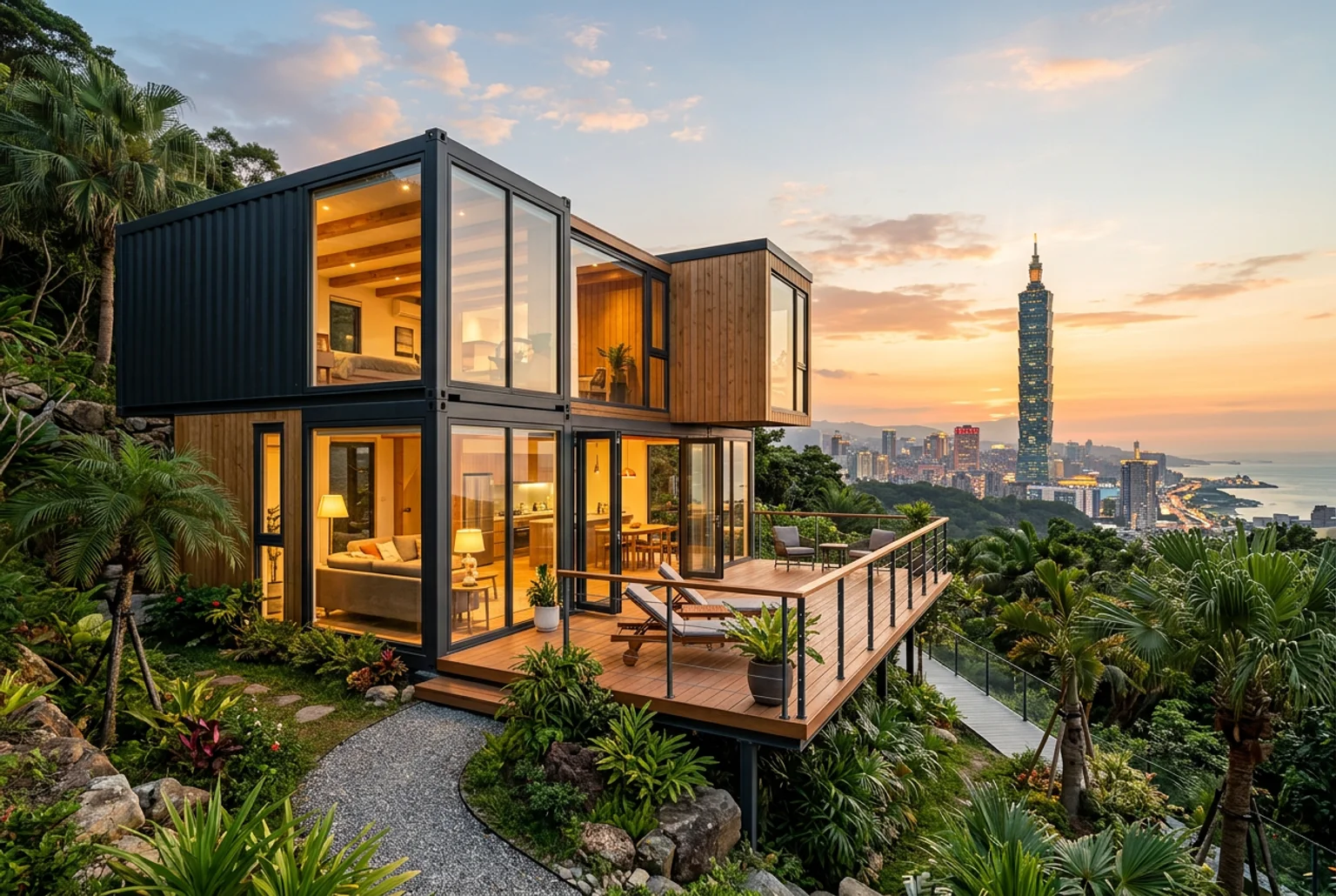
Container baches are the single highest-volume application. A 20ft or 40ft expandable container on a Coromandel or Bay of Plenty section delivers a lockable, low-maintenance holiday home for a fraction of the cost of a traditional bach build — and it can be relocated or resold if the owner’s plans change. Tourism operators in Queenstown and Rotorua increasingly use space capsule and expandable containers as boutique accommodation units, attracted by fast setup, distinctive aesthetics, and a payback period measured in months rather than years.
Container House Prices in New Zealand (2026)
Prices below follow the EasiHive global price system (2026): flat pack from $1,800, expandable from $4,500, folding from $2,000, space capsule from $4,000 for 20ft models. All factory prices are FOB (Ex-Works) from the China factory, including standard finishes and export packaging.
Factory Price by Type and Size
| Model | Factory Price (FOB) — 20ft | Factory Price (FOB) — 40ft |
|---|---|---|
| Flat Pack Container House | $1,800–$2,500 | $3,200–$4,500 |
| Folding Container House | $2,000–$4,000 | $3,500–$6,500 |
| Expandable Container House | $4,500–$6,000 | $8,000–$12,000 |
| Space Capsule Container House | $4,000–$15,000 | $8,000–$22,000 |
Landed Cost to New Zealand Ports (per unit)
| Model | Landed Auckland | Landed Tauranga | Landed Wellington | Landed Christchurch (Lyttelton) |
|---|---|---|---|---|
| 20ft Flat Pack | $3,500–$5,200 | $3,600–$5,400 | $3,800–$5,600 | $4,000–$5,800 |
| 40ft Flat Pack | $5,500–$8,000 | $5,600–$8,200 | $5,900–$8,500 | $6,200–$8,800 |
| 20ft Folding | $3,800–$6,500 | $3,900–$6,700 | $4,100–$7,000 | $4,300–$7,200 |
| 20ft Expandable | $6,800–$9,200 | $6,900–$9,400 | $7,200–$9,800 | $7,500–$10,100 |
| 40ft Expandable | $11,500–$16,500 | $11,700–$16,800 | $12,000–$17,200 | $12,400–$17,600 |
| Space Capsule (20ft) | $7,000–$19,500 | $7,100–$19,800 | $7,400–$20,200 | $7,700–$20,600 |
| Labor Camp Dormitory (per unit) | $3,000–$5,200 | $3,100–$5,400 | $3,300–$5,600 | $3,500–$5,800 |
Landed cost includes factory price, ocean freight, port handling, customs clearance, and applicable duties. New Zealand GST (15%) is additional and payable on the total landed value. South Island ports (Christchurch/Lyttelton, Bluff) add NZ$200–$600 per unit versus Auckland due to longer inland logistics or transhipment. Bulk orders of 10+ flat pack units load 6–8 per 40ft container, cutting per-unit freight by 40–60%.
For the full cost breakdown and per-type shipping math, see our Container House Cost Guide.
Need precise New Zealand pricing for a specific model? Request a quote and we will confirm the exact landed cost for your port and quantity.
Additional New Zealand Costs to Budget
| Item | Typical Cost |
|---|---|
| Customs duty (0–8% on prefab structures) | NZ$0–NZ$400 per unit |
| GST (15% on CIF value + duty) | 15% of total |
| Port handling & wharf charges | NZ$400–NZ$800 |
| Customs broker fee | NZ$250–NZ$500 |
| Inland transport (port to site) | NZ$500–NZ$3,000 by distance |
| Foundation (concrete piers or slab) | NZ$2,000–NZ$6,000 |
| Utility connections (plumbing, electrical) | NZ$3,000–NZ$8,000 |
| Building consent & council fees | NZ$1,500–NZ$5,000 |
| LBP inspection & sign-off | NZ$500–NZ$1,500 |
Shipping to New Zealand
Main New Zealand Ports
| Port | Region | Transit Time from China | Best For |
|---|---|---|---|
| Auckland | North Island (upper) | 4–5 weeks | Auckland, Northland, Waikato, Bay of Plenty |
| Tauranga | North Island (east) | 4–5 weeks | Bay of Plenty, Rotorua, Eastern BOP |
| Wellington | North Island (lower) | 5–6 weeks | Wellington region, lower North Island |
| Lyttelton (Christchurch) | South Island | 5–6 weeks | Canterbury, Christchurch rebuild areas |
| Port Chalmers (Dunedin) | South Island | 6–7 weeks | Otago, Southland, lower South Island |
Auckland is the primary import port for container houses bound for New Zealand — it has the highest container throughput, the shortest transit time from China, and the most competitive port handling rates. Most North Island buyers ship to Auckland and arrange local transport from there. South Island buyers typically route through Lyttelton (Christchurch’s port) for Canterbury, or Port Chalmers for Otago and Southland.
Shipping Cost per Unit (China to NZ)
| Container Type | Shipping Cost (to Auckland) |
|---|---|
| Flat Pack (20ft) | $1,200–$2,000 |
| Folding (20ft) | $1,400–$2,200 |
| Expandable (20ft) | $1,800–$3,000 |
| Space Capsule (20ft) | $2,500–$4,000 |
Shipping costs vary with global freight rates, container availability, and seasonal demand. Book early for the September–November window (NZ spring) when bach and construction demand peaks.
NZ Import Duties and GST
New Zealand applies customs duties on imported prefabricated buildings based on the Harmonised System classification:
| HS Code | Description | Typical Duty Rate |
|---|---|---|
| 9406.00 | Prefabricated buildings | 0–8% (depends on material and components) |
| 7308 | Steel structures and parts | 0–5% |
New Zealand GST (15%) is applied to the CIF (Cost, Insurance, Freight) value plus any duty. On a $5,000 landed-value unit with $200 duty, the GST payable would be NZ$780 (15% of $5,200). GST-registered businesses can claim input credits.
For bulk or camp orders (10+ units), EasiHive coordinates with your customs broker to optimise the HS classification and consolidate documentation, which can reduce per-unit clearance costs. See our China Container House Manufacturer Guide for the full export process.
Compliance and Building Standards for New Zealand
Container houses in New Zealand must comply with the New Zealand Building Code (NZBC) and referenced standards. Councils require a building consent for any container structure used as a habitable building, and all structural work must be signed off by a Licensed Building Practitioner (LBP).
| Standard | What It Covers |
|---|---|
| NZBC (New Zealand Building Code) | National building regulations — structure, fire, moisture, energy efficiency, accessibility |
| NZS 3404:1997 | Steel Structures Standard — design and fabrication of steel members and connections |
| NZS 1170.5:2004 | Earthquake Actions — seismic design loads and detailing for NZ earthquake zones |
| NZS 1170.2:2002 | Wind Actions — design wind speeds by region, including Wellington’s extra-high wind zone |
| NZS 1170.3:2003 | Snow and Ice Actions — roof snow loads for South Island alpine regions |
| NZS 4218:2009 | Energy Efficiency — minimum insulation (R-value) requirements by climate zone |
| Building Act 2004 | Legislative framework for building consents, inspections, and code compliance |
| NZS 3604:2011 | Timber-Framed Buildings — referenced for internal fit-out; container structural design follows NZS 3404 |
EasiHive containers are engineered to NZBC structural requirements. We provide structural documentation and engineering sign-off to support building consent applications through Licensed Building Practitioners (LBPs). Our engineering package includes steel connection details per NZS 3404, seismic load calculations per NZS 1170.5, wind load analysis per NZS 1170.2 for your specific site zone, and energy efficiency compliance documentation per NZS 4218.
Building Consent Process
- Pre-application meeting — discuss your container house project with your local council’s building consent team
- Consent application — submit NZBC compliance documentation (structural, fire, energy), site plan, foundation design, and utility connections
- Council review — typically 20 working days for standard residential consents (fast-track may be available for simple single-unit installations)
- Inspections — foundation, structural, plumbing/electrical, and final inspection by council BCOs
- Code Compliance Certificate (CCC) — issued on completion; essential for insurance, resale, and rental
Council consent fees for container homes typically range from NZ$1,500–NZ$5,000 depending on complexity and council area. Canterbury councils (post-earthquake) have streamlined processes for relocatable and modular buildings.
Climate-Specific Solutions for New Zealand
New Zealand’s climate ranges from subtropical in Northland to alpine in Queenstown and Central Otago. High wind zones (Wellington is among the windiest cities in the world) and seismic risk are present nationwide. Specify insulation, glazing, and structural design for your region:
| Region | Climate Challenge | Recommended Specification |
|---|---|---|
| Auckland / Northland | Subtropical humidity, warm temps | 50–75mm PU insulation, enhanced ventilation, moisture barriers, anti-mould interior coatings |
| Christchurch / Canterbury | Cold winters, hot dry nor’westers, seismic | 75–100mm PU insulation, seismic-rated base connections (NZS 1170.5), double glazing, heating provisions |
| Wellington | Extreme wind, moderate temps, seismic | Wind-rated connections (NZS 1170.2 extra-high wind zone), 75mm PU insulation, secure anchoring, low-profile design |
| Queenstown / Central Otago | Alpine cold, snow, intense UV | 100mm PU insulation, snow-load-rated roof (NZS 1170.3), triple glazing, UV-resistant exterior coatings |
| Hamilton / Waikato | Cool winters, warm summers, high rainfall | 75mm PU insulation, moisture management, standard wind rating |
| Bay of Plenty / Coromandel | Coastal humidity, salt air, mild winters | 50–75mm PU, anti-corrosion marine-grade coating, ventilation, salt-resistant fittings |
| Dunedin / Southland | Cold, wet, moderate snow | 75–100mm PU insulation, moisture barrier, heating provisions, wind-rated for coastal sites |
Design Features for New Zealand Conditions
- Seismic-rated steel connections — all structural joints detailed to NZS 1170.5 for NZ’s active seismic zones
- Wind-rated design — engineered for New Zealand’s high and extra-high wind zones (particularly Wellington and coastal sites)
- 75–100mm PU insulation — exceeding NZS 4218 minimum R-values for all NZ climate zones
- Anti-corrosion marine coating — hot-dip galvanised or marine-grade paint for coastal and island sites
- Elevated foundation options — steel or concrete piers for sloped sections, flood-prone areas, and uneven terrain
- Double or triple glazing — thermal performance meeting NZBC energy efficiency requirements
- Ventilation design — mechanical or passive ventilation to manage NZ’s high moisture levels
Installation Guide for New Zealand
Step-by-Step Process
-
Site assessment — evaluate access (trucks need ~4m wide clear access), ground conditions, slope, and proximity to utilities. For remote sections (Coromandel, Waiheke Island), confirm barge or helicopter delivery feasibility.
-
Foundation preparation — most NZ sites use concrete pier foundations (4–6 piers for a 20ft unit, 6–8 for 40ft) or a reinforced concrete slab. Canterbury sites in TC2–TC3 zones may require geotechnical assessment and specific foundation design per the ground conditions.
-
Consent application — submit NZBC compliance documentation, structural engineering, site plan, and foundation design to your local council. Allow 20 working days for standard processing.
-
Order and shipping — confirm your model, specifications, and quantity. Production takes 15–25 days; shipping from China to Auckland takes 4–5 weeks. Total order-to-port time is typically 8–12 weeks.
-
Delivery and placement — flat pack units arrive in a standard shipping container and are unloaded with a forklift or crane. Expandable and capsule units are lifted directly from the truck onto the foundation. A site crane adds NZ$800–NZ$2,000 if forklift access is not possible.
-
Assembly and fit-out — flat pack units assemble in 4–8 hours with basic tools. Expandable units unfold and lock into place in 2–4 hours. Electrical and plumbing connections are completed by licensed tradespeople.
-
Council inspections and CCC — foundation, structural, plumbing, and electrical inspections. Final Code Compliance Certificate issued on completion.
-
Move in — total project timeline from order to occupancy is typically 12–16 weeks, versus 6–12 months for conventional NZ construction.
Container Houses vs Traditional New Zealand Construction
| Option | Cost per m² (all-in) | Build Time | Notes |
|---|---|---|---|
| Traditional timber-frame | NZ$2,500–$4,500 | 6–12 months | Standard NZ method; highest cost |
| Prefab/modular (NZ-made) | NZ$2,000–$3,500 | 3–6 months | Factory-built in NZ; faster but still NZ labour costs |
| Relocatable home (second-hand) | NZ$800–$1,500 | 1–3 months | Limited supply; may need significant renovation |
| Container house (flat pack) | NZ$800–$1,800 | 2–4 weeks | Fastest, most cost-effective option |
| Container house (expandable) | NZ$1,200–$2,500 | 4–8 weeks | Residential finishes, 2–3x floor area |
| Container house (capsule) | NZ$1,500–$3,000 | 4–8 weeks | Tourism and premium applications |
The container advantage is widest in high-cost regions: Auckland (where conventional build costs exceed NZ$3,500/m²), Queenstown (where tourism demand drives construction labour rates even higher), and Christchurch (where seismic compliance adds NZ$200–$500/m² to conventional builds).
New Zealand Container Home Suppliers & Where to Buy
New Zealand has a growing but still small domestic container-home sector. The main local suppliers and channels are:
- Flexicube (flexicube.co.nz) — self-described “New Zealand’s leading container home builders”; sells DUO, SOHO, Coastal Luce and Palms ranges with free nationwide delivery and DIY/custom options.
- Portable Dwellings (portabledwellings.co.nz) — container homes from NZ$38,500 incl. GST (20ft, 1–3 bedroom) to NZ$64,000 (40ft, 3–4 bedroom, 72m²).
- SEA Containers NZ (seacontainers.co.nz) — container sales, hire and modification; publishes a “shipping container homes NZ cost & planning” guide.
- Space Cabins NZ (spacecabins.co.nz) — NZ-built portable cabins, pods, domes and A-frames.
- Absolute Tiny Houses (absolutetinyhouses.co.nz) — container and tiny homes.
- Taylor Made Container Homes (shippingcontainerhomesnz.co.nz) — design, planning and build.
- Tiger Containers (tigercontainers.co.nz) — custom container builds and conversions.
- Trade Me (trademe.co.nz) — New Zealand’s largest marketplace, with a dedicated “container homes” classifieds category for second-hand and new units.
Which should you choose? A local supplier gives you a turnkey, consent-ready unit without managing an import — but at NZ$38,500–$64,000+ for a 20–40ft build. Importing a factory-direct container house (like EasiHive) lands a 20ft unit in Auckland for NZ$3,500–$5,200 + GST, with the trade-off being that you coordinate shipping and local fit-out. For buyers comparing the two routes, see our How to Import a Container House guide.
Local vs Imported Container Homes: The Price Reality Check
The single biggest decision for NZ buyers is local-build versus imported. Here is what the two routes actually cost:
| Option | 20ft unit (incl. GST) | 40ft / 3–4-bed | Lead time | Notes |
|---|---|---|---|---|
| Portable Dwellings (NZ-made) | NZ$38,500+ | NZ$64,000 (40ft, 72m²) | ~8–12 wks | Local build; highest NZ labour & material cost |
| Flexicube (NZ-made) | Estimate NZ$45,000+ (price on enquiry) | — | — | Self-described “leading” builder; no public pricing |
| EasiHive landed in Auckland | NZ$3,500–5,200 (+GST) | NZ$6,800–9,200 (expandable) | 8–12 wks | FOB factory-direct; 5–10× cheaper before fit-out |
| EasiHive fully installed bach | NZ$25,000–50,000 all-in | — | 12–16 wks | Includes foundation, utilities, consent |
Why the 5–10× gap? New Zealand construction labour runs NZ$60–90/hour and building materials carry premium island pricing; local suppliers build one-off units in small yards. EasiHive produces at scale in certified Chinese factories and ships flat-pack to your NZ port, removing most of the local labour and material premium. The trade-off is that you manage shipping and arrange local foundation, plumbing, and electrical work — which is exactly why an installed bach still lands well below a local turnkey build.
Building Consent Myths: Is “No Consent Required” True in NZ?
Some NZ suppliers — most visibly Flexicube — advertise container homes with “NO Building or Resource Consent Required.” This is misleading for any habitable dwelling.
Under the Building Act 2004, a building consent is required for any structure used for human habitation, whether it is a timber house, a prefab, or a shipping container. A “no consent required” claim only applies to very limited temporary or non-habitable structures (typically under 10m², detached, non-sleeping). A container bach, home, office, or rental will almost always need:
- a building consent (with NZBC compliance and LBP-signed structural work), and
- potentially a resource consent where your site zoning, setbacks, or density rules require it.
EasiHive does not market around consent loopholes. We supply the NZBC compliance documentation, seismic (NZS 1170.5) and wind (NZS 1170.2) engineering, and LBP-ready paperwork so your council application is straightforward. If a supplier tells you “no consent required” for a livable home, treat it as a red flag and confirm with your local council.
Internal Links: Related Market Guides
New Zealand buyers often compare options across the Asia-Pacific region. These guides provide useful context:
- Container Houses in Australia — closest market comparison; similar climate zones in Victoria and Tasmania
- Container Houses in Japan — another island nation with strict seismic codes and high construction costs
- Container Houses in South Korea — comparable housing affordability challenges in Seoul
- How to Import a Container House — step-by-step import process for any country
- Container House Buying Guide — global buyer’s checklist
- Container House Cost Guide 2026 — full cost breakdown by type and region
- Container House Comparison — flat pack vs expandable vs folding vs capsule
- Flat Pack Container House Guide — the most popular format for NZ construction sites
- Expandable Container House Guide — ideal for baches and residential use
- Space Capsule Container House Guide — premium tourism and glamping
- China Container House Manufacturer Guide — how to verify and select a factory
FAQ
Are container houses legal in New Zealand?
Yes. Container houses are legal in New Zealand when they comply with the New Zealand Building Code (NZBC). A building consent is required from your local council, and all structural work must be signed off by a Licensed Building Practitioner (LBP). EasiHive provides the NZBC compliance documentation and structural engineering to support your consent application.
Can container houses handle New Zealand earthquakes?
Yes. New Zealand is one of the most seismically active countries in the world, and our container houses are specifically engineered for NZ earthquake zones. Steel connections are designed to NZS 1170.5 (Earthquake Actions), with seismic load calculations specific to your site’s seismic hazard zone. This is one of the key advantages of steel-framed container construction over timber for earthquake-prone NZ sites.
How much does a container house cost in New Zealand?
Factory price starts at $1,800 for a 20ft flat pack, $2,000 for folding, $4,500 for expandable, and $4,000 for a space capsule. Landed in Auckland, a 20ft flat pack costs $3,500–$5,200; a 20ft expandable costs $6,800–$9,200. Add 15% NZ GST, customs duty (0–8%), foundation, utilities, and consent fees. A fully installed, consented 20ft expandable container bach typically totals NZ$25,000–NZ$50,000 depending on site conditions and fit-out level.
How long does shipping to New Zealand take?
Shipping from China to Auckland takes 4–5 weeks. Tauranga and Wellington ports take 5–6 weeks. Christchurch (Lyttelton) and Dunedin (Port Chalmers) take 5–7 weeks. Total time from factory order to delivery on site is typically 8–12 weeks including production (15–25 days) and booking.
Are container houses good for baches?
Container houses are excellent for baches. They are durable, lockable, low-maintenance, relocatable, and significantly cheaper than a traditional bach build. Container baches are particularly popular in Coromandel, Bay of Plenty, Mount Maunganui, Wanaka, and the Kaikoura Coast. A 20ft expandable unit makes a comfortable one-bedroom bach; a 40ft expandable provides two bedrooms and a full kitchen for family holidays.
Do I need a building consent for a container house in NZ?
Yes, for any habitable container structure. Building consent is required under the Building Act 2004. However, some councils allow minor or temporary structures (under 10m², non-habitable) without consent. For a container bach, home, office, or rental unit, plan for a full consent process. Canterbury councils have streamlined processes for modular and relocatable buildings post-earthquake.
Can container homes withstand Wellington’s wind?
Yes. Wellington sits in one of the highest wind zones in New Zealand, and our units are engineered to NZS 1170.2 (Wind Actions) for extra-high wind zones. This includes wind-rated connections, low-profile design options, and secure anchoring systems. Specify your site’s wind zone with your order and we will provide the appropriate wind load engineering.
What customs duties and GST apply to container houses in NZ?
Container houses imported into New Zealand attract a customs duty of 0–8% (depending on HS classification of the building components) plus 15% GST applied to the CIF value plus duty. On a $5,000 landed-value unit with $200 duty, the total import cost (duty + GST) would be approximately NZ$1,000. GST-registered businesses can claim input tax credits on the GST paid.
Can I put a container house on my farm in New Zealand?
Yes. Container houses are widely used on New Zealand farms for farmworker accommodation, farm offices, storage, and workshops. Rural properties often have more relaxed setback and consent requirements, and farm buildings may qualify for simplified consent processes depending on the council. We supply flat pack and expandable models suitable for rural NZ sites with concrete pier foundations for varied terrain.
How long do container houses last in New Zealand’s climate?
With proper engineering and maintenance, container houses in New Zealand last 20–30 years or more. Key factors: marine-grade anti-corrosion coating for coastal sites, adequate insulation to prevent condensation (critical in NZ’s humid climate), and regular maintenance of exterior coatings. Steel-framed container houses are inherently resistant to rot, termites, and fungal attack — all common issues for timber buildings in NZ’s damp climate.
Are there New Zealand container home companies?
Yes. New Zealand’s domestic container-home sector includes Flexicube (flexicube.co.nz), Portable Dwellings (portabledwellings.co.nz), SEA Containers NZ, Space Cabins NZ, Absolute Tiny Houses, Taylor Made Container Homes, and Tiger Containers. You can also find new and used units on Trade Me. Local suppliers charge NZ$38,500–$64,000+ for a 20–40ft build; importing factory-direct (like EasiHive) lands a 20ft unit in Auckland for NZ$3,500–$5,200 + GST. Compare the two routes in our import guide.
Can I buy a container home on Trade Me?
Yes. Trade Me (trademe.co.nz) — New Zealand’s largest marketplace — has a “container homes” classifieds category with both new and second-hand units. Used containers can be cheap but often need significant renovation, refurbishment, and consent work; new Trade Me listings are frequently resold by the same local suppliers above. Weigh the unknown condition of a used unit against a new, NZBC-engineered imported unit with full documentation.
Do I really need building consent for a small container home in NZ?
For anything you sleep in or live in — yes. Under the Building Act 2004, a building consent is required for any habitable structure, including a small container home, bach, or sleepout. Some suppliers advertise “no consent required,” but that only applies to very limited non-habitable structures (typically under 10m²). For a livable container, plan for both a building consent and possibly a resource consent. EasiHive supplies the compliance documentation to make the process straightforward.
Get a Quote for New Zealand
Contact EasiHive for factory-direct pricing to New Zealand. We:
- Engineer to NZBC, NZS 3404, NZS 1170, and NZS 4218 with documentation for building consent
- Ship to Auckland, Tauranga, Wellington, Christchurch (Lyttelton), and Dunedin (Port Chalmers)
- Provide seismic-rated, wind-rated, and climate-specific specifications for every NZ region
- Support bach, residential, farm, tourism, and construction site applications
- Offer LBP-ready engineering documentation for council building consent
- Supply everything from single backyard baches to 50+ unit worker accommodation camps
Send your location, unit type, and quantity, and we will return a line-item landed-cost quote for your New Zealand port within one business day.
Related Guides
- Container Houses in Australia
- Container Houses in Japan
- Container House Cost Guide 2026
- Container House Buying Guide
- Container House Comparison
- How to Import a Container House
- Flat Pack Container House Guide
- Expandable Container House Guide
- Space Capsule Container House Guide
- China Container House Manufacturer Guide