Quick Answer
Buy container houses in Taiwan. Flat pack, expandable, folding container homes for residential, construction, tourism, and disaster relief. Earthquake and typhoon resistant. China factory direct.
The Taiwan Container House Market in 2026
Taiwan is one of Asia’s most urbanized and expensive housing markets, and in 2026 it is also one of the most dynamic markets for container houses. The forces pushing Taiwanese buyers toward factory-built steel housing are unusually strong — and unusually specific.
Housing prices. Taipei’s average home price per square meter has climbed steadily for years, and the price-to-income ratio is among the highest in Asia. For young families, renters, and first-time buyers in New Taipei, Taoyuan, and Taichung, a conventional apartment purchase is out of reach, but a 20ft or 40ft container unit — fully finished, delivered, and installed for a fraction of an apartment down payment — is achievable. The same economics drive the market for farm stays, mountain cabins, and holiday units on land that traditional construction would price at multiples of the container cost.
Construction and industrial demand. Taiwan’s infrastructure pipeline — metro extensions, urban renewal, offshore wind farms, and the semiconductor build-out around Hsinchu, Taichung, and Tainan science parks — generates continuous demand for site offices, worker dormitories, canteens, and security gatehouses. A construction crew of 100 workers needs 25 to 30 container units; a factory expanding in a science park needs them in weeks, not the months a concrete structure would take. Contractors increasingly buy flat pack units by the container load because they install in hours, relocate between project sites, and can be sold on after a project ends.
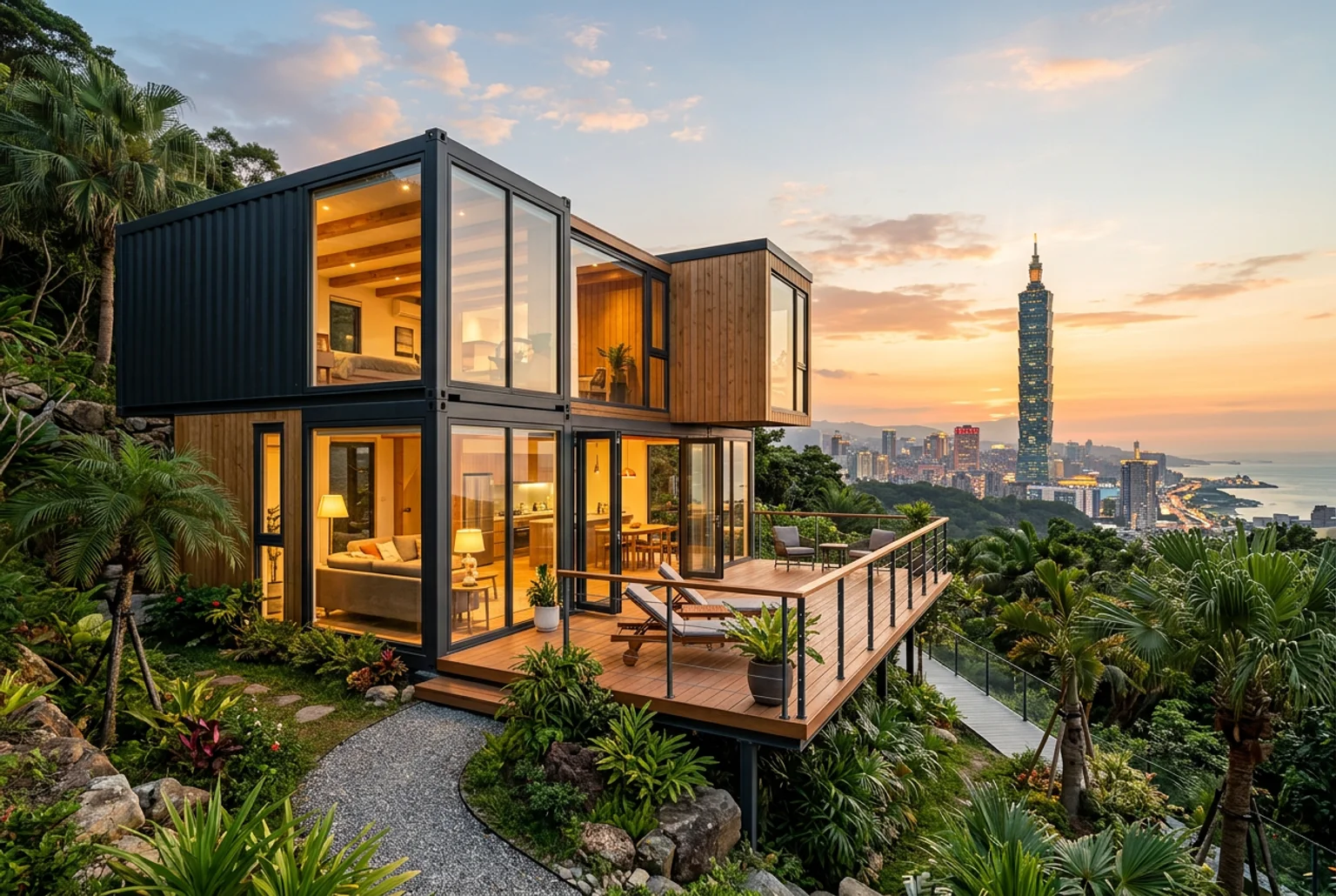
Tourism. Kenting, Hualien, Cingjing Farm, and the east coast are the backbones of Taiwan’s domestic tourism boom. Glamping and B&B operators in these areas have discovered that container cabins look premium, install on an existing hillside or orchard lot with minimal excavation, and cost a small fraction of a reinforced-concrete or timber lodge. A 20ft expandable unit with a deck rents for an average nightly rate that pays the unit back in one to three seasons.
Natural disaster resilience. Taiwan sits on one of the most active seismic belts on the planet — the 1999 Chi-Chi (921) earthquake killed over 2,400 people — and is hit by three to five typhoons every year. After major earthquakes and floods, emergency housing must deploy in days. Folding and flat pack container units, warehoused and pre-engineered, are Taiwan’s practical answer for transitional housing that is actually seismic and typhoon rated, unlike tents and temporary shelters. Government agencies, county disaster centers, and NGOs increasingly procure container units for exactly this reason.
Semiconductor support facilities. TSMC and its suppliers have expanded capacity so aggressively — in Taichung, Hsinchu, Kaohsiung, and overseas — that support housing and services buildings trail fab investment by years. Container accommodation for construction crews, security posts, canteens, and on-site offices is the fastest way to fill that gap without waiting on long-lead concrete structures.
Underlying all of this is a simple price fact. A factory-built steel container house from China is delivered to a Taiwan port for far less than the equivalent space built conventionally, and the sea route from mainland China to Taiwan is among the shortest and cheapest in the world. This guide covers the full picture for Taiwanese buyers: applications, factory and landed prices, import and customs procedure, Taiwan’s building and seismic regulations, climate specifications by region, camp budgets, ROI math, supplier selection, and the ten questions Taiwanese buyers ask us most.
Why Container Houses for Taiwan?
| Benefit | Impact in Taiwan |
|---|---|
| Earthquake Resistant | Welded steel frames engineered to Taiwan seismic zones; far stronger than brick-and-wood construction in a magnitude 6+ quake |
| Typhoon Rated | Engineered to resist super-typhoon winds (17級風); strapped and anchored units survive storms that damage ordinary lean-tos |
| Fast Deployment | Flat pack installs in 2–4 hours per unit; a 30-unit camp is livable in under a week — versus months for concrete |
| Low Cost | Roughly 30–60% cheaper all-in than reinforced concrete or timber construction per square meter |
| Land Flexibility | Sits on piers, concrete pad, or gravel — no deep foundation, minimal site disruption, works on slopes and orchards |
| Modular Expansion | Add rooms, kitchens, washrooms, or a second floor by joining standard units together |
| Relocatable | Move or resell the unit when a lease, a project, or a zoning rule changes |
| Quick Planning | Temporary use often needs only a simple approval; permanent homes follow a clear, documented permit path |
| Low Maintenance | Galvanized steel frame and fire-resistant panels; 20–30 year service life with routine care |
| Factory Quality | Precision fabrication, consistent finishes, pre-wired and pre-plumbed — built in a controlled environment, not on site |
Taiwanese buyers choose container houses for one dominant reason: a finished, durable, code-engineered structure at roughly half the price of conventional construction, delivered in weeks instead of months. Flat pack models remove the biggest site constraint of all — they arrive as a compact kit that two to four workers and a small forklift assemble in a day, with no welding and no crane, which works on tight hillside or urban lots where a crane cannot reach.
Popular Applications in Taiwan
| Application | Recommended Type | Location Examples |
|---|---|---|
| Factory & Plant Worker Housing | Flat Pack / Labor Camp Dormitory | Hsinchu, Taichung, Kaohsiung science parks |
| Construction Site Offices | Flat Pack | Taipei, Taoyuan, Kaohsiung metro projects |
| Glamping & B&B Cabins | Expandable / Folding | Kenting, Cingjing, Hualien, Yilan |
| Vacation & Mountain Homes | Expandable / Space Capsule | Alishan, Sun Moon Lake, east coast |
| Emergency & Post-Disaster Housing | Folding | Earthquake and flood response, county shelters |
| Agricultural Sheds & Farm Stays | Flat Pack | Tainan, Changhua, Yunlin farming belts |
| Retail Kiosks & Food Stands | Flat Pack | Night markets, campus, highway rest stops |
| Warehouse & Storage | Flat Pack | Industrial districts, ports |
| Schools & Training Centers | Flat Pack / Expandable | Rural counties, temporary classrooms |
| Temples & Community Centers | Flat Pack | Village halls, religious facilities |
| Offshore Island Facilities | Flat Pack / Expandable | Kinmen, Penghu, Matsu (corrosion-enhanced spec) |
Worker housing and glamping are the two highest-velocity segments. A factory or contractor buying 10–100+ units for dormitories and site offices gets the deepest bulk pricing, while the tourism sector buys single expandable or folding units, installs them on idyllic slopes, and rents them at premium nightly rates. Emergency agencies keep folding units in rotation — stored flat, deployed by truck within days of a disaster.
資材室 (Agricultural Sheds): Taiwan’s Fastest-Growing Container Use
資材室 (nóng yòng zī cái shì, agricultural storage/work sheds) is one of the most-searched container applications in Taiwan, and for good reason: a 資材室 on registered farmland (農業用地) is one of the few structures Taiwanese farmers can build with a simple notification to the township office (公所) rather than a full building permit, as long as it stays within the area limit (typically 45 m² — comfortably met by a 20ft container’s 14.7 m² footprint or a 40ft unit at ~29 m²). That makes a flat pack container the fastest, cheapest compliant structure for orchards, rice paddies, tea farms, and vegetable plots across Tainan, Changhua, Yunlin, Chiayi, Pingtung, and the east coast. The same unit later upgrades into a farm stand, packing shed, or temporary worker shelter. Buyers in this segment typically order 1–3 flat pack units and install them in a single weekend with two helpers. Ask your township 公所 about the current 資材室 regulations before ordering — rules vary slightly by county, and a compliant unit is the difference between a one-week notice and a full permit application.
Container House Dimensions (貨櫃屋尺寸)
Taiwanese buyers price and size container houses in 坪 (ping), so the standard dimensions matter more here than anywhere. Here are the exact sizes of EasiHive’s standard units — the numbers that answer “一個貨櫃幾坪” and “貨櫃屋尺寸” in one table:
| Model | External Dimensions (L×W×H) | Internal Floor | Ceiling Height | Equivalent in 坪 |
|---|---|---|---|---|
| 20ft Flat Pack | 6,058 × 2,438 × 2,800 mm | ~14.7 m² | 2,600 mm | ~4.5 坪 |
| 40ft Flat Pack | 12,192 × 2,438 × 2,800 mm | ~29 m² | 2,600 mm | ~8.8 坪 |
| 20ft Expandable (closed) | 6,058 × 2,438 × 2,800 mm | ~14.7 m² | 2,600 mm | ~4.5 坪 |
| 20ft Expandable (opened) | 6,058 × 5,438 × 2,800 mm | ~32 m² | 2,600 mm | ~9.7 坪 |
| 40ft Expandable (opened) | 12,192 × 5,438 × 2,800 mm | ~66 m² | 2,600 mm | ~20 坪 |
| Space Capsule | 4,200 × 2,600 × 2,900 mm | ~9 m² | 2,900 mm | ~2.7 坪 |
A 20ft unit is 1 坪 = 3.306 m². The practical takeaway for Taiwanese buyers: a 20ft flat pack delivers about 4.5 坪 of finished interior, a 40ft unit about 8.8 坪, and an opened 40ft expandable about 20 坪 — at a fraction of the per-坪 cost of RC construction. For the full global dimension and weight tables, see the Container House Specifications Guide.
Container House Prices in Taiwan (2026)
Prices below are consistent with the EasiHive global price system (2026): flat pack from $1,800, expandable from $4,500, folding from $2,000, space capsule from $4,000 for 20ft models. All factory prices are FOB (Ex-Works) from the China factory, including standard finishes and export packaging.
| Model | Factory Price (FOB) | Landed Keelung | Landed Taichung | Landed Kaohsiung |
|---|---|---|---|---|
| 20ft Flat Pack | $1,800–$2,500 | $2,300–$3,300 | $2,250–$3,200 | $2,200–$3,150 |
| 40ft Flat Pack | $3,200–$4,500 | $4,100–$5,700 | $4,000–$5,600 | $3,900–$5,500 |
| 20ft Folding | $2,000–$4,000 | $2,600–$4,800 | $2,550–$4,700 | $2,500–$4,650 |
| 20ft Expandable | $4,500–$6,000 | $5,300–$7,100 | $5,200–$7,000 | $5,100–$6,900 |
| 40ft Expandable | $8,000–$12,000 | $9,400–$14,000 | $9,200–$13,800 | $9,000–$13,600 |
| Space Capsule | $4,000–$15,000 | $5,200–$17,500 | $5,100–$17,300 | $5,000–$17,100 |
| Labor Camp Dormitory (bulk, per unit) | $1,300–$2,000 | $1,700–$2,600 | $1,650–$2,550 | $1,600–$2,500 |
Landed cost includes the factory price, ocean freight, customs clearance (duty and business tax), and port handling. Because the China–Taiwan sea route is short (one to four days in port-to-port transit), the freight difference between ports is small — measured in a few hundred dollars per unit, not thousands. Kaohsiung is the largest and busiest port and usually the least expensive for southern Taiwan; Keelung serves Taipei and the north; Taichung splits the difference for central projects. Shipping concentrates to whichever port is closest to the final site, because inland trucking from Kaohsiung to Taipei can cost more than the sea leg itself.
Need a precise quote for your port and quantity? Request a quote and we will confirm the exact landed cost to Kaohsiung, Keelung, or Taichung for your mix of units.
Additional Taiwan Costs to Budget
| Item | Cost |
|---|---|
| Customs clearance agent fee (報關行) | NT$3,000–$8,000 per shipment |
| Import duty (CCC 9406 prefab steel buildings) | roughly 5–10% of CIF value, confirmed at booking |
| Business tax (營業稅) | 5% on the CIF + duty base |
| Port handling / container terminal charges | NT$5,000–$15,000 |
| Inland trucking (port to site) | NT$8,000–$40,000 by distance and unit size |
| Foundation (per unit) | NT$20,000–$80,000 |
| Utility connections (typical house) | NT$50,000–$150,000 |
| Crane or forklift rental for installation | NT$8,000–$20,000 per day |
Shipping to Taiwan
Main Ports
| Port | Region Served | Transit Time from China | Best For |
|---|---|---|---|
| Keelung | Taipei, northern Taiwan | 2–4 days | Northern projects, Taipei metro area |
| Taichung | Central Taiwan | 2–3 days | Taichung, Changhua, Miaoli, Nantou |
| Kaohsiung | Southern Taiwan | 2–3 days | Kaohsiung, Tainan, Pingtung, eastern Taiwan |
| Taipei Harbor (RMB bridge) | Alternative for the north | 2–4 days | Container freight via Taipei port services |
Shipping Cost (per 20ft unit)
| Type | Cost |
|---|---|
| Flat Pack | $300–$600 |
| Folding | $350–$650 |
| Expandable | $500–$900 |
| Space Capsule | $800–$1,500 |
Flat pack units consolidate 6–8 per 40ft container, which is why bulk camp orders cut per-unit freight by 40–60% versus shipped-assembled units. Bulk buyers planning 25+ units should always price the container-load option rather than per-unit freight.
Inland Transportation
Taiwan is small and its highways are excellent, so the last leg is fast and reliable. Expect most sites to be within a half-day of any of the three main ports. For delivery beyond the port, you can arrange your own flatbed truck or have your freight forwarder quote door-to-door (DDP) delivery to your site.
Port choice rule of thumb: route to the port nearest your site — the sea-leg price difference is negligible, but inland trucking is billed per kilometer and adds up quickly across the island.
Importing a Container House to Taiwan
Importing a container house from China to Taiwan is a routine, well-established process for licensed customs brokers (報關行). Here is exactly how it works.
1. CCC Code and Duty Rates
Taiwan’s customs classification system (CCC, 中華民國商品標準分類) follows the international HS system to six digits. A complete prefabricated building of iron or steel enters under CCC 9406.20 (prefabricated buildings of iron or steel), with a base import duty that is typically 5–10% depending on the precise binding tariff schedule. Related classifications:
| CCC Code | Description | Typical Duty |
|---|---|---|
| 9406.20 | Prefabricated buildings of iron or steel | 5–10% |
| 9406.90 | Prefabricated buildings of other materials | 5–10% |
| 7308.90 | Steel structures and parts | varies by chapter |
Some suppliers ship units as flat-panelled components that customs could in theory classify under Chapter 73 (steel structures). In practice, entering complete buildings under 9406 keeps the documentation clean and matches the building-permit paperwork, so most importers classify the full unit under 9406.20. Your broker confirms the exact rate for your precise cargo at booking time — and EasiHive provides the full classification documentation (commercial invoice, packing list, certificate of origin, and BL) your broker needs.
2. Who Can Import
You can import as either a registered Taiwanese company (using your 統一編號 (unified business tax ID)) or as an individual. Companies clear goods faster and can reclaim the 5% business tax paid at import when it is used in their own taxable business. Individuals use a licensed customs broker who acts as the customs declarant (報關人). Either way, a licensed broker handles the entry.
3. Customs Clearance Steps
- Shipment departs China with full export documentation (invoice, packing list, bill of lading).
- Vessel arrives at Kaohsiung, Taichung, or Keelung.
- Your broker (報關行) files the import declaration (進口報單) with Taiwanese Customs (海關關務署).
- Duty (關稅) and business tax (營業稅) are assessed on the CIF value and paid.
- Customs inspects if flagged (for container houses this is usually a document review, occasionally a physical inspection).
- Cargo is released for pickup or trucking to your site.
4. ECFA Consideration
The Economic Cooperation Framework Agreement (ECFA, 兩岸經濟合作架構協議) between Taiwan and mainland China includes an early-harvest list of goods that enter at zero tariff. Prefabricated buildings have generally not been included in the ECFA early-harvest list, so container houses imported from China pay the standard duty rate. Do not assume zero-duty treatment under ECFA — confirm the effective rate with your broker at booking. There is also no additional “anti-dumping” surcharge specifically applied to prefab container buildings at the time of writing, but tariff schedules change, so a current broker quote is always the source of truth.
5. Choosing Clearance Points
Clear through the port nearest your site (see port table above), or consolidate 6–8 flat pack units in a single container for a camp or development. For first-time importers, a door-to-door (DDP) quote from your China supplier — where the supplier’s forwarder handles freight, clearance, and delivery to your Taiwanese address — removes most of the friction. EasiHive supports both DDP and EXW/FOB deliveries and provides full documentation for every shipment.
For the step-by-step global version with production, QC, and payment timeline, see How to Import a Container House from China.
Compliance Requirements in Taiwan
Taiwan regulates buildings under the Building Act (建築法) and its companion regulation, the Building Technical Regulations (建築技術規則), enforced by the Ministry of the Interior and local construction authorities. Consideration:
| Requirement | What It Covers |
|---|---|
| Building Act (建築法) | Ownership, permits, construction supervision, administrative approval |
| Building Technical Regulations (建築技術規則) | Structural design, fire resistance, ventilation, height, setbacks |
| Seismic Design Standard (耐震設計規範及解說) | Design ground acceleration by region, seismic zones, ductility |
| CNS Standards | Steel materials (e.g., CNS 2111 steel structures), panel and material testing |
| Fire Safety Code (消防法) | Fire-fighting equipment, exits, fire-resistance ratings for occupied buildings |
| Temporary Building Rules (臨時建築物) | Time-limited structures approved for events, camps, and short-term use |
The core question every Taiwanese buyer starts with — permanent or temporary?
- Temporary use (臨時性建築物): Many container deployments — site offices, worker camps, emergency shelters, event buildings — qualify as temporary structures. Under the Building Act’s temporary-building provisions, these can be set up with the local authority’s permission (報准) or under specific regulatory exemptions, without a full building permit, usually for a defined period (commonly 3–5 years, renewable in some cases). This is the fast, low-cost path used by contractors and event organizers.
- Permanent use: A container house used as a permanent residence, B&B, or commercial building must follow the normal path — a building permit (建造執照) from the local government, compliance with the Building Technical Regulations (structure, fire, electrical, sanitation), and a usage permit (使用執照). Steel-framed container units that ship with structural and engineering documentation are the easiest prefab option to submit through this process, because the steel frame’s seismic and load performance is already calculated.
Seismic design is non-negotiable in Taiwan. The island’s design ground acceleration zones (design PGA) rank among the highest anywhere; the east coast and Hualien–Taitung corridor are in the most demanding zones. Panels and interiors on a seismic-spec unit are not just bolted but braced, corner posts are reinforced, and door/window openings are detailed so rotation during a quake does not eject glazing. Specify “Taiwan seismic spec” with your order; EasiHive provides the structural engineering documentation (with computations mapped to Taiwan’s seismic zones) that your 技師/建築師 (professional engineer/architect) needs for the permit file.
Fire safety: occupied units must meet the Fire Safety Code’s requirements for exits, alarms, extinguishers, and, for sleeping occupancy, fire-resistance of the envelope. Container panels are factory-filled with non-combustible or fire-rated core materials (rock wool or high-grade PU), and door/window sets arrive with fire-rated options for sleeping rooms.
An honest note: building laws are enforced locally (county/city), and a structure that breezes through Taitung may face a stricter review in Taipei. Have a local 建築師 (architect) or licensed 結構技師 (structural engineer) review the drawings before you buy — it is the difference between a two-week approval and a two-month correction.
For a deeper treatment of regulations in a neighboring code environment, see Container Houses in Japan and Container Houses in South Korea.
How High Can You Stack a Container House in Taiwan? (貨櫃屋高度限制)
One of the most common questions Taiwanese buyers ask is how many floors a container house can have — the height and stacking limits. The short answer: a single-story container is the simplest path, and most temporary container structures stay at one or two stories, but the exact limit depends on whether the structure is temporary or permanent, and on your county’s local enforcement.
| Scenario | Typical Height | What It Takes |
|---|---|---|
| Single-story container (20ft / 40ft) | ~3.0–3.5 m (2.8 m unit + roof & foundation) | Simple notification or temporary-building approval |
| Two containers stacked (2 stories) | ~6.0–7.0 m total | Structural engineer’s calculation; often moves into the permanent permit path |
| Three or more stories | 9 m+ | Full building permit + Building Technical Regulations compliance |
Key rules to know:
- Temporary buildings (臨時性建築物) are the fast path. Most counties limit temporary container structures to one or two stories and a modest overall height, so a single-story unit or a two-unit stack is almost always the easiest approval.
- Single-story height is not a practical constraint: a standard 20ft or 40ft unit is about 2.8 m high internally (roughly 3.0–3.5 m with roof and piers), far below any height ceiling.
- Stacking a second floor adds real engineering work. The steel frame handles it, but the combined seismic and typhoon loads must be recalculated by a structural engineer (結構技師), and the connection detail between stacked units is the critical joint.
- Permanent homes fall under the Building Technical Regulations (建築技術規則), where total building height is governed by your land’s zoning, building coverage ratio (建蔽率), and floor area ratio (容積率) — not by the container itself.
- Steel-framed containers can physically stack two to three floors when engineered, but every added floor raises the foundation, lateral-bracing, and fire-escape requirements.
Stacking Five Flat Pack Units: What Taiwan Actually Allows
A frequent question from buyers planning a dormitory, a hostel, or a multi-family block is whether they can stack five flat pack container units to get five floors of space. The short answer: a five-unit stack is not a temporary building in Taiwan — it is a permanent multi-story structure, and it moves your project out of the simplified notification path entirely.
| Stacked Levels | Approx. Height | How Taiwan Treats It | Realistic? |
|---|---|---|---|
| 1 level (single 20ft/40ft) | ~3.0–3.5 m | Temporary-building notification; often exempt for 資材室 or farm structures | Yes — fastest approval |
| 2 levels | ~6.0–7.0 m | Temporary structure with a structural engineer’s calculation (結構技師) | Yes, common |
| 3 levels | ~9.0–10.5 m | Usually reclassified permanent; full building permit | Possible, costly |
| 4–5 levels | 12–17 m | Permanent building under 建築技術規則: full permit, seismic review, fire-escape routes, and in some zones an elevator | Not practical for container units |
Why five levels fails in practice comes down to four constraints acting together:
- The temporary-building height cap — most Taiwanese counties limit temporary container structures to one or two stories, so a five-high stack cannot use the simplified path at all.
- Seismic and typhoon lateral loads — beyond two stories the wind and earthquake forces must be re-engineered, and the corner-post connection between stacked units becomes the governing structural detail.
- Building Technical Regulations (建築技術規則) — once permanent, your land’s 建蔽率 (building coverage ratio) and 容積率 (floor area ratio) govern the buildable envelope, not the container’s dimensions.
- Foundation capacity — Taiwan’s soft coastal and reclaimed soils usually force an upgrade from piers to piles once you pass two stories.
If you need that much floor area, the economical answer is not to stack five high — it is to place five units side by side on one pad. A single-story row stays inside the temporary-building path, needs no multi-story fire-escape design, and costs a fraction of an engineered tower. Where vertical space genuinely is required, the practical ceiling for container construction in Taiwan is two engineered stories.
Practical guidance: if you only need one level — a 資材室, a glamping cabin, a farm stay, or a site office — a single-story container clears the height rules trivially. If you want two floors, budget for a structural engineer’s review and confirm the county’s temporary-building height limit before you commit, because enforcement varies by county and city. For the full permitting path, see the Taiwan Worker Camp guide and the Taiwan Seismic & Typhoon guide.
Climate-Specific Solutions by Region
Taiwan is small but climatically diverse: sub-tropical humidity in the north, tropical heat in the south, alpine cold high in the mountains, and typhoon and seismic hazards everywhere. Specify insulation, corrosion protection, and anchoring for your region:
| Region | Climate Challenge | Recommended Specification |
|---|---|---|
| Keelung & North Coast | 200+ rainy days a year, persistent humidity | 50–75mm PU, vapor barrier and moisture management, treated floor joists, mold-resistant interior panels, generous roof overhang |
| Taipei Basin | Humid sub-tropical, hot summers | 50–75mm PU, cross-ventilation, AC provisions, dehumidifier-friendly interior |
| Hsinchu & Taoyuan | High winds (九降風), industrial air | 75mm PU, extra tie-down straps, sealed window gaskets, corrosion treatment |
| Taichung & Central | Mild, less rain, medium typhoon exposure | 50–75mm PU, balanced spec, typhoon strapping |
| Chiayi / Tainan | Hot humid summers, heavy rain bursts | 75mm PU, reflective cool roof, elevated floor, deep eaves |
| Kaohsiung & South | Tropical, long hot season, high UV | 75mm PU, reflective cool roof, UV-resistant exterior coating, AC provisions |
| Pingtung / Kenting | Tropical coast, salt air, first typhoon landfall | 75mm PU, marine-grade corrosion steel, typhoon-rated straps, impact-resistant glazing |
| Hualien / Taitung (East Coast) | Highest seismic zone, typhoon corridor | Seismic bracing per Taiwan stress zones, reinforced corner posts, typhoon anchoring, flexible utility connections |
| Mountain Areas (Cingjing, Alishan, Hehuanshan) | Cool highland, fog, cold nights | 75–100mm PU, heating provisions, condensation drainage, triple-layer weather seals |
| Offshore Islands (Kinmen, Penghu, Matsu) | Strong winds, salt spray, limited water | Corrosion-treated steel, wind-rated anchoring, water storage and plumbing hardening, 75mm PU |
Ask for a regional engineering memo with your quote: EasiHive provides the seismic and wind calculations for your city or county’s design values, which is exactly what local inspectors want in the permit jacket.
Factory & Site Dormitory: 100-Worker Camp Budget
Taiwan’s labs, science parks, and construction sites need worker housing in a hurry. A 100-person camp built from flat pack dormitory units is the standard solution. Here is a complete budget:
| Component | Configuration | Cost |
|---|---|---|
| 25 dormitory units (4 bunks each) | 20ft flat pack labor dorm, bulk price | $32,500–$50,000 |
| 3 shared washroom / shower units | 20ft, pre-plumbed, 4 stalls each | $6,000–$9,000 |
| 2 canteen / kitchen units (linked) | 2–3 units joined, 100 seats | $6,400–$10,500 |
| 1 laundry + storage unit | 20ft flat pack | $1,800–$3,000 |
| 1 office / security gatehouse unit | 20ft flat pack | $1,800–$3,000 |
| Ocean freight + clearance (30 units) | Bulk container loads, DDP | $9,000–$19,000 |
| Foundation, utilities, installation | Piers, power, water, drainage, 2-week crew | $10,000–$25,000 |
| Total (all-in) | 100-person live-in camp | $67,500–$119,500 |
That is roughly $675–$1,200 per bed — a fraction of renting hotels for a 12-month project, and the camp is yours to reuse at the next site or resell. Assembly of 30 units by a 6–8 person crew typically takes 7–10 days. For the deeper procurement playbook, see the Labor Camp Dormitory Procurement Guide and the Container Worker Camps in Taiwan: B2B Guide, which covers unit types, the temporary-building approval path, and deployment timelines specific to Taiwan’s factories and science parks.
Container vs. Traditional Construction: Investment Math
| Option | Cost (per m², all-in) | Build Time | Notes |
|---|---|---|---|
| Reinforced concrete (RC) building | NT$50,000–NT$90,000 | 8–14 months | The local default; slowest and most expensive |
| Timber / light steel frame | NT$30,000–NT$60,000 | 4–8 months | Better pricing, longer maintenance |
| Container house (flat pack) | NT$15,000–NT$30,000 | 2–4 weeks | Landed + installed, best bang for buck |
| Container house (expandable) | NT$25,000–NT$45,000 | 4–8 weeks | Residential finishes, 2–3× floor area |
(At 2026 exchange rates, US$1 ≈ NT$31–32; 1 m² ≈ 0.3025 坪.)
The container advantage is widest exactly where Taiwan’s pain points are: high construction labor costs, long permit-to-build cycles, and land parcels that are too small, sloped, or remote for a conventional build. For glamping, farm stays, and mountain cabins, the comparison is even more lopsided because the container needs almost no foundation and leaves the land intact.
B&B / Glamping Investment Example (Kenting or Cingjing)
| Scenario | Nightly Rate (NT$) | Occupancy | Annual Revenue (NT$) | All-in Unit Cost (NT$) | Simple Payback |
|---|---|---|---|---|---|
| 20ft expandable cabin, 2 guests, off-grid solar | $4,000–$6,000 | 60–70% | $900,000–$1,500,000 | $350,000–$550,000 | ~4–7 months |
| 20ft folding cabin, budget glamping | $2,500–$4,000 | 50–65% | $450,000–$950,000 | $180,000–$320,000 | ~4–8 months |
| Space capsule, premium hillside view | $6,000–$10,000 | 55–70% | $1,200,000–$2,500,000 | $450,000–$900,000 | ~5–11 months |
Even at conservative occupancy, a container B&B cabin typically pays for itself within one season. The caveat: Taiwan’s B&B rules (民宿管理辦法) restrict where and how many rooms a 民宿 (B&B) may operate, and which buildings qualify — license your operation with the local government and confirm your site’s zoning before you build.
Choosing a Container House Supplier for Taiwan
Sourcing for Taiwan is different from any other market: you need a China factory that has shipped repeatedly to Kaohsiung, Taichung, and Keelung, understands Taiwan’s seismic and Building Technical Regulations documentation, and can deliver code-caliber engineering without you managing every step from across the strait.
Checklist for Taiwanese Buyers
- Real manufacturer, not a trader — request a live video tour; ask for the factory’s business license and production-line photos/test records. See how to verify a China container house factory.
- Taiwan seismic spec engineering — confirm the supplier will deliver structural engineering documentation mapped to Taiwan’s seismic zones, ready for your 結構技師 or 建築師 to use in the permit file.
- CNS / material documentation — material certificates for the steel frame, insulation, and panels that satisfy CNS testing references.
- ISO 9001 certification — quality-management systems for repeatable fabrication.
- Taiwan export experience — ask for references of past shipments to Taiwan and their customs broker contacts.
- Clearance support — does the supplier’s forwarder offer DDP to your Taiwanese address, or will you use your own 報關行 (customs broker)?
- Typhoon-packaging — shipping to Taiwan crosses typhoon-season waters year-round; confirm watertight export packaging and marine insurance are in place.
- Pre-shipment inspection — third-party inspection (SGS, Bureau Veritas) before the container is sealed, plus photos/video of packing.
- Spare parts and warranty — a 5-year structural warranty plus a spare-parts kit for doors, windows, and fittings shipped with your order.
- Payment terms — T/T with a production-linked deposit schedule, or escrow for large camp orders.
EasiHive is a China container house manufacturer with regular Taiwan shipments, units engineered to windward and seismic specs, dual-language documentation, and a dedicated Taiwan sales channel that coordinates clearance and port delivery to Kaohsiung, Taichung, or Keelung. Request a supplier quote.
Typical Taiwan Use Cases and the Specs They Need
Taiwanese buyers cluster around a handful of applications, and each one drives a different specification:
| Use case | Recommended unit | Specification focus |
|---|---|---|
| Betel-nut stand or roadside kiosk | 20ft, single-face opening | Shade and ventilation; full-width opening for signage; corrosion protection matters more than services |
| Site office or rest room | 20ft flat pack | Fast deployment and easy relocation; high cube improves comfort |
| Guardhouse or security post | 20ft with WC | Air conditioning and insulation; plan crane access at the gate |
| Worker dormitory | 20ft, four berths, stackable | Occupancy area, fire egress and ventilation rules; stacking needs structural certification |
| Warehouse or farm material store | 20ft / 40ft | On farmland the permitted agricultural facility route applies (up to 45 m²) |
| B&B or glamping unit | 20ft / 40ft with wet-and-dry bathroom | Insulation and airtightness; wind and corrosion protection on mountain and coastal sites |
| Holiday cabin | 40ft high cube | Mezzanine and large glazing; hillside sites need soil-and-water conservation approval |
FAQ
Are container houses legal in Taiwan?
Yes, with the right approvals. Temporary uses — site offices, camps, event buildings, emergency shelters — can be set up under the Building Act’s temporary-building provisions with local permission for a defined period. A permanent residence, B&B, or commercial building needs the normal building permit and usage-permit process, which container units pass when their engineering documentation is in order. Container houses in Taiwan are widely and legally used at every level.
Do I need a building permit for a container house?
For permanent use, yes — a building permit (建造執照) and later a usage permit (使用執照). For temporary or short-term use (worker camps, site offices, emergency housing), a lighter local approval or regulatory exemption usually applies. Have a local architect or structural engineer confirm which path your site and use fall into before you commit.
How many floors can a container house be in Taiwan?
A single-story container clears the rules easily — a standard 20ft or 40ft unit is about 2.8 m high internally (roughly 3.0–3.5 m with roof and foundation). Most temporary container structures stay at one or two stories, and a two-unit stack (about 6–7 m) generally needs a structural engineer’s calculation. Permanent multi-story homes are governed by your land’s zoning and the Building Technical Regulations, not by the container itself. Confirm your county’s local height limit before stacking.
Are container houses safe during earthquakes?
Yes, when engineered for it. Taiwan’s seismic zone requires steel frames that are braced, corner-reinforced, and detailed so glazing stays put during a quake. EasiHive units with the Taiwan seismic spec include structural computations mapped to the island’s design ground-acceleration zones. The steel structure is routinely stronger than unreinforced brick or older RC in a large quake.
Can container houses survive typhoons?
Yes. Units are tied down with typhoon-rated anchors and straps, and the steel frame resists gusts far beyond ordinary site sheds. Specify your county’s design wind speed and typhoon strapping with your order; coastal and east-coast deployments should add marine corrosion treatment and impact-resistant glazing.
What import duties and taxes apply?
Complete prefabricated steel buildings enter under CCC 9406 with a base duty that is typically 5–10% of CIF value, plus 5% business tax (營業稅) on the CIF + duty base, plus clearance agent and port handling fees. ECFA early-harvest treatment generally does not apply to prefab buildings, so plan for the standard rate; your broker confirms the exact figure at booking.
Can I get financing for a container house?
Business buyers (companies, B&B operators, contractors) can finance container camp and cabin purchases through corporate credit, equipment loans, or asset-backed lending because the units are movable assets with a resale market. For individuals, personal loans or mortgage add-ons work where the structure is permanent and permitted; check conditions (農業用地 / agricultural land restrictions on borrowing against farm structures). Talk to your bank after the structure is permitted — a documented steel-frame unit is more financeable than an unpermitted build.
How long does shipping take from China to Taiwan?
Production takes 15–25 days for a full container load; sea transit from mainland China to Keelung, Taichung, or Kaohsiung is 2–4 days. Plan roughly 4–6 weeks total from factory order to arrival, or about 6–8 weeks including foundation, installation, and handover.
How are the units assembled?
Flat pack units assemble with bolts — two to four workers and a small forklift complete a 20ft unit in 2–4 hours; a 30-unit camp takes about a week. Expandable units arrive folded and unfold on site in 30–60 minutes each with a crane for placement. Folding units need no crane beyond their own mechanism. No welding is required on site.
Can I sell or move the unit later?
Yes — this is one of the biggest advantages. Bolted flat pack units dismantle and re-pack for relocation to a new site, which is why contractors and camps routinely reuse them across projects. There is a healthy secondhand market for container houses in Taiwan, so a well-maintained unit typically retains meaningful resale value.
Can I put a container house on agricultural or rural land?
Regulations vary by county and land-use zone. Sloped agricultural land can host temporary farm-use and agritourism structures (with the right approvals), but permanent housing on farmland is restricted by the zoning regime. This is the single most common approval surprise for Taiwanese buyers — confirm your land’s zoning and permitted uses with the county government before you order, and keep the structure’s use consistent with what you applied for.
What is the height limit for a container house in Taiwan?
Taiwan permits multi-story container buildings; a typical finished floor height is about 2.8-3.0 m, and stacked configurations (often up to roughly 5 floors) are feasible with reinforced steel framing and compliance with the Building Act and local zoning. Always confirm the exact limit with your city building office before design.
Get a Quote for Taiwan
Contact EasiHive for factory-direct pricing to Taiwan. We:
- Engineer to Taiwan seismic and typhoon specs with structural documentation for your 建築師 (architect) or 結構技師 (structural engineer)
- Ship to Kaohsiung, Taichung, and Keelung with DDP delivery to your site
- Provide clearance-ready documentation (invoice, packing list, certificate of origin, BL)
- Support bulk worker-housing orders for factories, contractors, and science-park expansions
- Offer B&B and glamping configurations proven in Kenting, Cingjing, and the east coast
- Supply everything from a single backyard unit to 100+ unit labor camps
Send your city, unit type and quantity, and we will return a line-item landed-cost quote for your port within one business day.
Related Guides
- Container House Price per Ping in Taiwan
- Container House Dimensions in Taiwan (坪)
- Earthquake & Typhoon Safety in Taiwan
- Container House B&B (民宿) in Taiwan
- Importing a Container House to Taiwan
- Container Houses in Japan
- Container Houses in South Korea
- Container Houses in Philippines
- Container Houses in Indonesia
- How to Import a Container House from China
- Container House Buying Guide
- Container House Cost Guide 2026
- Container House Comparison
- Container House Specifications Guide
- Container House Disadvantages & Fix Costs
- Container House Buying Guide Taiwan (12 Checks)
- Verify a China Container House Supplier
- Labor Camp Dormitory Procurement Guide
- China Flat Pack Container House Manufacturer Guide
- Container vs Modular House in Taiwan
- Is a Container House Legal in Taiwan?
- Taiwan Horse Ranch Staff Dormitory Case Study